 Parrot Blog
How to Avoid Parrot Scams: From CITES Verification to Health Checks
Discover 4 key verification points to avoid parrot scams. Learn how to safely adopt high-value species like Macaws and Grey Parrots, from checking official CITES registrations to performing health exams.
 Naviary
Introduction
The biggest concern when adopting a parrot is "how to find a good seller."
In Korea, the pet industry still revolves around pet shops and cafes. Compared to the breeding cultures in Europe or the US, the process is often less transparent.
About 10 years ago, there was a time when CITES individuals without documents were traded in cash. Recently, while the number of sellers marketing on SNS has increased, there are still many things to be cautious about.
Finding a Reliable Seller
Identifying a scammer can be harder than you think. They are often very good at creating plausible stories with skilled speech.
Among breeders promoting on SNS, there are cases of blatant scams, so I've summarized some basic verification points.
Point 1. Verify "CITES Farm" Claims First
CITES Appendix I species have very restricted import/export. To import them legally, an officially registered route is required.
The registration list can be checked on the official CITES website.
Check the CITES Registration List
If someone in Korea claims "We are a CITES farm," be suspicious.
Looking at the CITES registration list:
- 1 Scientific Facility (National Institute of Ecology)
- 4 Caviar Export Facilities
That's it. There are no CITES-registered captive breeding facilities or commercial breeding facilities for parrots in Korea.
In other words, if a seller says they are a "CITES farm," they are likely not a formally registered farm.
CITES Appendix I can only be imported from captive breeding facilities registered as CITES farms. CITES Appendix I species distributed in Korea must be:
- Individuals bred domestically, or
- Individuals imported from a CITES farm
CITES Appendix I Parrots that can enter Korea
| Species | Scientific Name | Notes |
|---|---|---|
| Red-vented Cockatoo (Philippine Cockatoo) | Cacatua haematuropygia | |
| Moluccan Cockatoo | Cacatua moluccensis | |
| Yellow-crested Cockatoo | Cacatua sulphurea | |
| Red-and-blue Lory | Eos histrio | |
| Yellow-headed Amazon | Amazona oratrix | Different from Yellow-fronted Amazon (Amazona ochrocephala) |
| Hyacinth Macaw | Anodorhynchus hyacinthinus | |
| Golden Conure | Guarouba guarouba | |
| Blue-headed Macaw | Primolius couloni | |
| African Grey Parrot | Psittacus erithacus | Many CITES-registered farms exist |
Point 2. Verify Documents for Imported Individuals
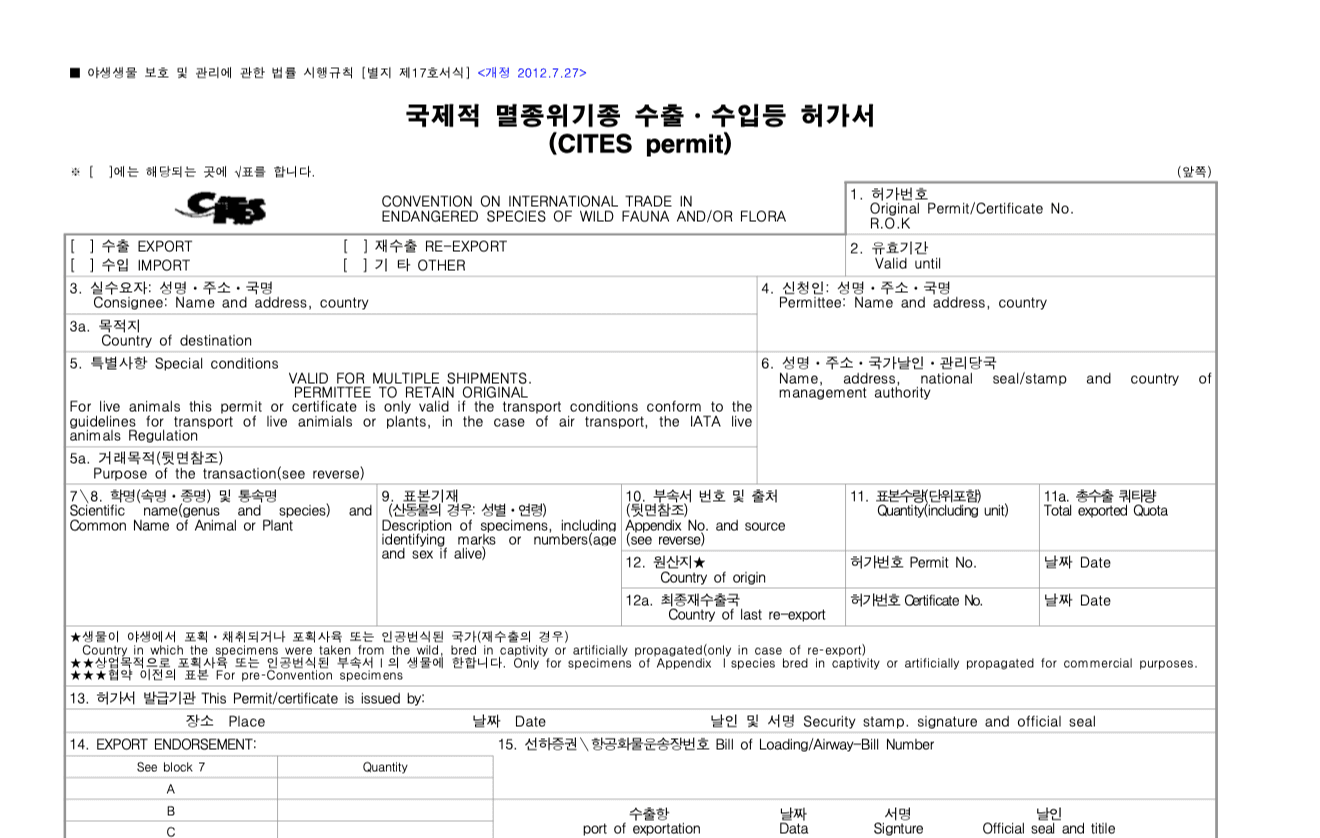
Korean CITES permit example
If a CITES Appendix I parrot is said to be "imported from overseas," records come before words.
It's a red flag if the following items are missing or if the explanation keeps changing:
Essential Checkpoints
- CITES Export/Import Permits/Certificates
- Individual identification information like microchips or leg bands
- If domestically bred: Origin/documents of parent birds, breeding history
In summary: If it’s not domestically bred, there must be import/export records. Without evidence, the possibility of illegal entry cannot be ruled out.
Point 3. Avoid Sellers Who Hide the Breeding Environment
Sellers who hide or are vague about the breeding environment (keeping space, hygiene management, etc.) are usually not reliable.
While small species can be managed in home breeding, the difficulty increases significantly when medium to large species are involved. As the number of birds increases, so do the risks of disease and transmission.
If you are considering a medium to large species:
- Choose places that disclose the breeding environment (photos, visitation possible, management methods)
- Choose places that answer questions consistently
I highly recommend these transparent sellers.
Point 4. Check for the 4 Major Diseases and Refund Policies
For medium to large species, disease issues can be costly and pose a risk to other birds.
Items to check before adoption:
- Whether tests for the 4 major diseases are possible
- If the seller cannot perform the test:
- Is a refund/compensation possible if an individual test comes back positive?
- What are the duration, conditions, required documents, and exceptions?
It's safe to agree on these clearly in advance.
Summary
A good seller is not someone who speaks well. It's someone who transparently shows verifiable evidence.
Especially for medium to large species, one choice determines the bird's entire life. Judge based on verification points rather than feelings or intuition.
Even with these criteria, it can be difficult for individuals to perfectly filter out cases that plausible bypass CITES.
That's why I hope an adoption process with minimum safety devices becomes a well-established culture.
Checklist:
- Source/Documents: Verify import/export records if not domestically bred
- Environment: Disclose breeding environment and provide consistent explanations
- Health: Agreement on 4 major disease testing + refund/compensation policies