
 Parrot Blog
Parrot PDD: Symptoms, Testing, Transmission, and Prevention
This guide covers the main symptoms of PDD in parrots, how testing is approached, its relationship with avian bornavirus, and key management principles for preventing spread.
 Naviary
Naviary Parrot Disease Guide
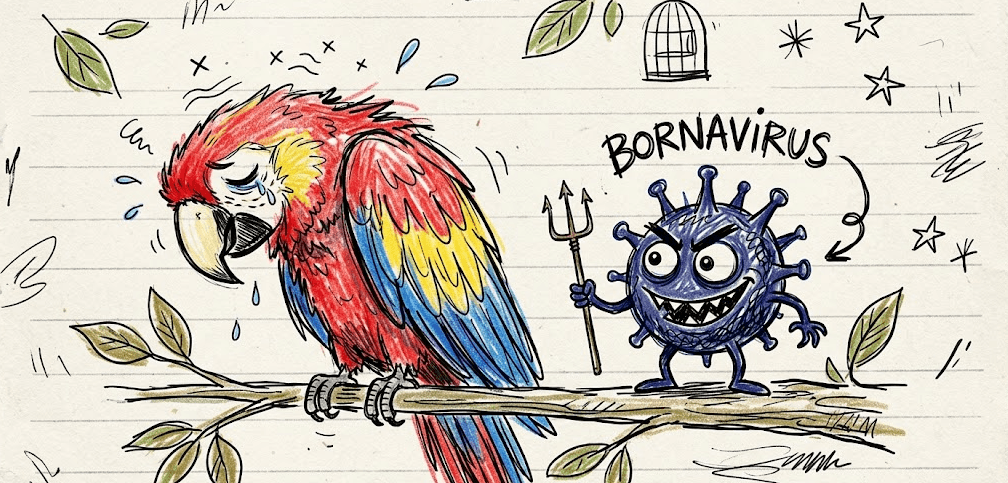
This article contains a photo of a parrot that died from PDD.
Introduction
If you keep parrots long enough, there are a few disease names you are almost guaranteed to come across.
PBFD, PDD, APV, psittacosis, and others like them. These are diseases every parrot guardian should know, but when you first hear those names, they can feel confusing and honestly a little scary.
Last time I covered PBFD, so this time I want to move on to the second topic in the series: PDD.
What is PDD?
PDD stands for Proventricular Dilatation Disease.
At first glance, the name can make it sound like a simple digestive disorder where the proventriculus becomes enlarged. But in reality, that is only part of the picture.
In the past, PDD was often called Macaw Wasting Disease because affected birds could keep eating and still continue to lose weight.
Today, with better diagnostic tools and research, it is understood as a neurologic disease associated with bornavirus infection, specifically ABV (Avian bornavirus). The virus can disrupt the nerves that help control the digestive tract, which is why the disease can show up in several different ways.
That is why proventricular enlargement should be understood as one possible manifestation, not the whole disease itself.
Just like our stomach and intestines move in rhythm to transport, process, and eliminate food, a parrot's digestive tract also depends on autonomic nerve control.
PDD affects the nervous system involved in regulating those digestive organs. As a result, one bird may show signs such as proventricular enlargement or poor gut motility, while another may show balance problems or unusual behavior instead.
What symptoms can appear?
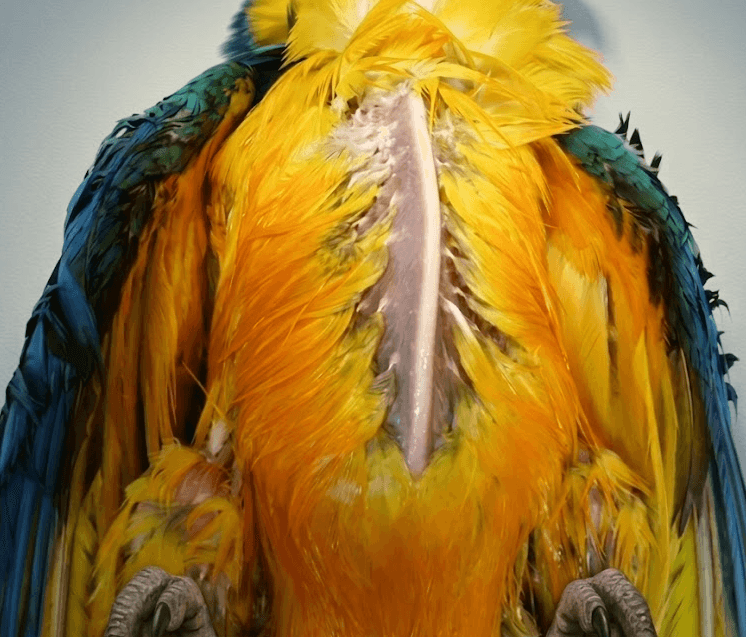
Warning: this section contains a photo of a bird that died from disease
This image may be distressing, so it is blurred by default. Reveal it only if you want to view the original.
PDD does not refer only to digestive disease. This virus can affect the brain, spinal cord, peripheral nerves, and even heart muscle.
The symptoms can look different depending on which part of the body the virus affects first. That is why some birds may show only mild, easy-to-miss signs at first, while others become much more obviously ill.
Broadly speaking, it helps to think about the signs in two groups: digestive signs and neurologic signs.
Digestive signs
The best-known changes are the digestive ones. Common examples include:
- weight loss
- reduced appetite
- vomiting
- diarrhea with undigested food in the droppings
- decreased intestinal motility
- proventricular enlargement
- continuing to lose weight despite eating
- a pronounced, knife-like breastbone from muscle loss
One of the most noticeable red flags for guardians is this: the bird keeps eating, but the body weight keeps dropping.
Neurologic signs
Neurologic signs often make PDD harder to recognize. As mentioned above, symptoms can vary depending on where the virus takes hold first, so some birds may show neurologic changes before obvious digestive problems.
Examples include:
- poor balance
- tremors
- lethargy
- unusual behavior that feels out of character
- abnormal walking
- seizures
Atypical signs
Some birds show more obvious digestive signs. Others first stand out because of neurologic changes. And some birds can appear almost normal for a while.
That is why, from a guardian's point of view, it is not easy to say, "This is definitely PDD."
Instead, what often happens is a slow buildup of small changes such as:
- gradual weight loss
- seeming a little off after eating, even if there is no obvious vomiting
- droppings that look different from usual
- getting worse at balancing
- generally lower condition than usual
Some birds show only part of this picture, and some show it very gradually.
How is PDD tested?
As I mentioned in the previous article, most testing in Korea is done with PCR. But PCR, on its own, is not 100% perfect, so it is important to interpret the result together with symptoms and a veterinarian's clinical opinion.
Both false positives and false negatives need to be considered.
There are also birds that carry the virus without obvious clinical signs, so even birds that appear healthy can still be worth testing. At Naviary, rather than thinking, "My bird looks healthy, so let me adopt one more right away," we strongly recommend confirming a clear negative disease screening result before adding another bird to the household.
If you keep multiple birds, you need to be especially careful
PDD is a highly consequential infectious disease. If you keep multiple parrots together, it does not stay a problem of just one individual. It can quickly become a management issue for the entire group.
In a detailed epidemiologic survey of major breeding facilities in Brazil, 73.7% of the birds tested were found to be infected with bornavirus. A significant number of them were asymptomatic carriers that showed no obvious clinical signs until very late.

An asymptomatic infection means the bird is infected with the virus but continues living without the characteristic signs people expect to see. That makes it very difficult for guardians to recognize.
In the end, prevention is a management problem
PDD is not easy to diagnose, and there is no definitive cure. So the best response a guardian can realistically make is still prevention and management.
- If you bring home a new bird, do not introduce the bird to the flock right away. Isolation is the most basic response to infectious disease risk. Keep the new bird separated until testing is done, and after handling that bird, disinfect the places and objects the bird used.
- Keep regular weight records. Parrots are very good at hiding that something is wrong. If you are not weighing them regularly, you may notice changes too late. By the time you think, "Did my bird get a little thinner?" the disease may already be fairly advanced. Consistent weigh-ins under similar conditions can help you suspect a problem much earlier.
- Watch droppings and eating responses together. Do not assume everything is fine just because the bird is still eating. Watch how the bird eats, whether undigested food appears in the droppings, and how the bird seems to feel after meals.
- Pay attention to abnormal signs. PDD is caused by a neurotropic virus, so neurologic signs can matter a lot. Balance problems, tremors, pupil abnormalities, or unusual behavior can all be clues worth taking seriously.
Finally, if something seems wrong, it is important not to wait too long. Visit an avian-capable veterinary hospital and get proper guidance. Early evaluation and supportive care matter most.
Conclusion
PDD carries a high risk of spread, and asymptomatic infection is a very real concern, so management and prevention really matter.
To summarize it briefly:
- PDD is not only a problem of proventricular enlargement
- asymptomatic infection, neurologic signs, and digestive signs are all possible
- transmission can happen through routes such as contaminated dust
- early testing matters, and results should never be interpreted without context
Of course, if you suspect PDD or your parrot simply seems unwell, it is much better to visit a nearby clinic than to rely on visual guesses alone. You can check nearby clinics through our service, Angmorning.
At Naviary, our operating principles for infectious disease control are:
- Immediately isolate any bird suspected of infection
- If a suspected case appears, conduct a full review of the breeding center population, including PCR testing of all birds
- Incinerate or sterilize all items used by the suspected bird
These are the principles we operate by. In a breeding center, infection in one bird can affect other individuals and the breeding program as a whole, so preventing spread and protecting the group must be managed more strictly than care for one individual alone.
And of course, preventing infection in the first place matters most. That is why prevention remains the highest priority in how we run the breeding center.
In the next article, I'll cover APV (Avian Polyomavirus).
References
-
Herbert Weissenböck, Tamás Bakonyi, Karin Sekulin, Felix Ehrensperger, Robert J. T. Doneley, Ralf Dürrwald, Richard Hoop, Károly Erdélyi, János Gál, Jolanta Kolodziejek, Norbert Nowotny. Avian Bornaviruses in Psittacine Birds from Europe and Australia with Proventricular Dilatation Disease. (2009)
-
Dominique L. Keller, Kirsi S. Honkavuori, Thomas Briese, W. Ian Lipkin, Anantharaman Muthuswamy, Howard Steinberg, Kurt K. Sladky. Proventricular Dilatation Disease Associated with Avian Bornavirus in a Scarlet Macaw (Ara macao). (2010)
-
Aila Solimar Gonçalves Silva, Tânia Freitas Raso, Erica Azevedo Costa, Sandra Yuliet Marin Gómez, Nelson Rodrigo da Silva Martins. Parrot bornavirus in naturally infected Brazilian captive parrots: Challenges in viral spread control. (2020)