
 Parrot Blog
Parrot PBFD: Symptoms, Testing, Transmission, and Prevention
PBFD is one of the best-known viral diseases in parrots. This guide covers the main symptoms of PBFD, how to interpret testing, transmission routes, asymptomatic infection, and prevention.
 Naviary
Naviary Parrot Disease Guide
Introduction
If you keep parrots long enough, there are a few disease names you will almost certainly run into.
PBFD, PDD, APV, psittacosis, and others like them. These are diseases every parrot guardian should at least know by name, but when you first hear about them, they can feel confusing and intimidating.
At Naviary, I want to organize these diseases one by one in a way that feels easier to understand.
And the first topic is probably the one you have heard the most: PBFD.
PBFD is often known as "the disease that causes feather loss" or "the disease that affects the beak." Among infectious diseases in parrots, it is widely considered one of the most serious and well-known.
Some birds show very obvious feather abnormalities, while others show almost no visible signs at all. Sometimes they look completely normal on the outside, yet the infection is only picked up through testing.
That is why you need to look at it even more carefully if you keep multiple birds or are planning to breed. This is not just a problem of "one sick bird." It can become a problem for the entire group.
In this article, I’ll go over what PBFD actually is, what kinds of signs it can show, how it spreads, and how to think about testing.
What kind of disease is PBFD?
PBFD stands for Psittacine Beak and Feather Disease. In Korean, you could simply call it "parrot beak and feather disease."
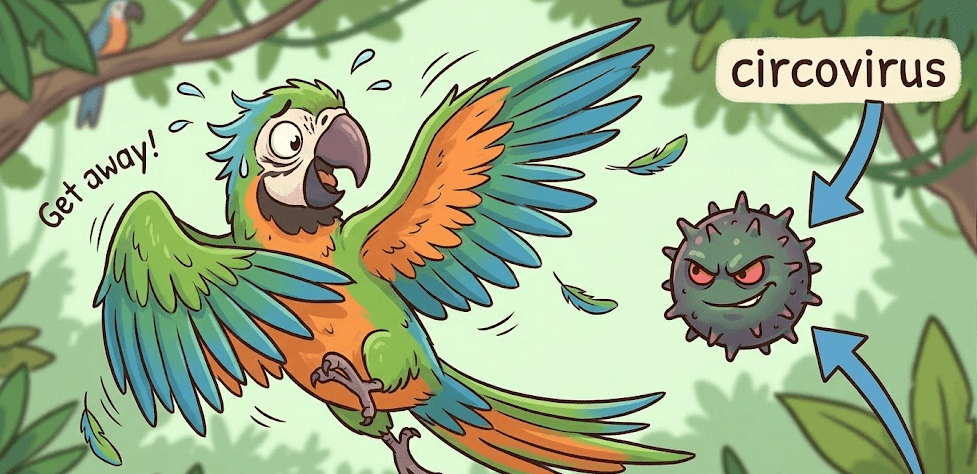
It is a viral disease caused by a circovirus, and it is known to spread very easily.
It is not quite enough to think of PBFD as just "a disease of the feathers and beak."
Research papers and review articles describe it as something that can be associated not only with feather abnormalities and deformities of the beak and claws, but also with immunosuppression. That is why some birds first show changes in feathers, claws, or the beak, while others may stand out more because of declining condition or secondary infections.
It can also progress more rapidly in young birds.
What symptoms can it show?
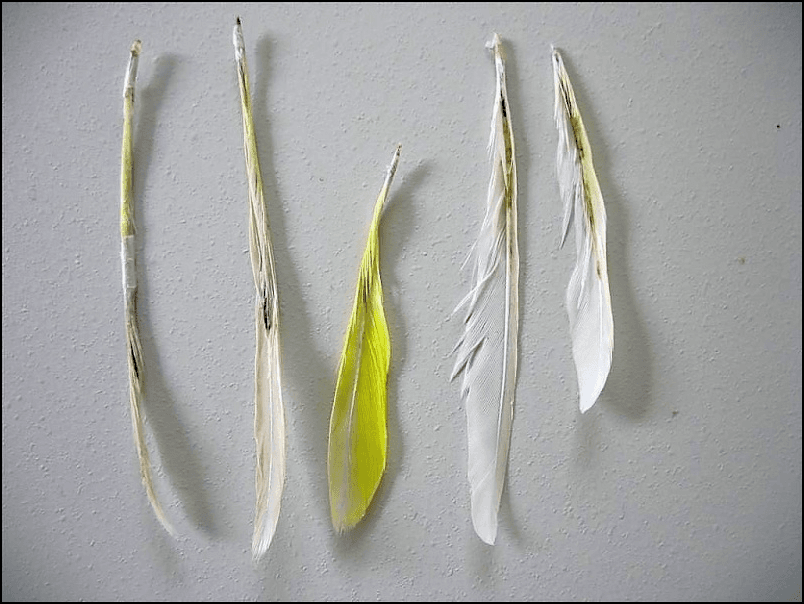
Feathers from a lovebird affected by PBFD
The best-known sign is, of course, feather change.
New feathers may grow in abnormally, break easily, remain partly enclosed in the feather sheath, or fall out in a more symmetrical pattern.
Depending on the species, feathers may also come in with colors different from what you would normally expect. For example, in green-feathered species, the appearance of yellow feathers can sometimes be mentioned as an early warning sign.
Beak changes are another classic sign.
As the disease progresses, the beak may become weak, crack, or grow in an abnormal shape. The claws can also be affected in a similar way.
That said, not every case of PBFD looks like the “classic” picture people immediately imagine.
In one report involving eight lovebirds, some birds started with relatively ambiguous findings such as changes in the beak surface or localized feather loss rather than dramatic, textbook feather damage.
PCR testing confirmed PBFD virus in all of those cases, and the sequences matched previously described PBFD cases 100%.
"The feathers are not damaged enough for it to be PBFD."
That kind of assumption can be dangerous.
How does PBFD spread?
It helps to think of PBFD as a disease that spreads largely through the environment.
Feather dust can break apart and become airborne, and the virus can also be associated with droppings, food passed from parent birds to chicks, and even contamination around eggs in breeding settings, which means chicks may be exposed very early.
In other words, the space where an infected bird lived, the dust it left behind, bodily material, and the surrounding contact environment can all become part of the transmission route.
This becomes even more sensitive in a breeding environment. The risk increases the moment you:
- bring in a new bird
- share cleaning tools or carriers
- assume a bird is safe just because it looks healthy
All of those moments can become risk points.
How should testing be done?
In Korea, the most realistic and practical option is usually PCR testing. It is one of the most commonly used ways to check for the virus in samples such as blood or feathers.
But this is where one point becomes especially important: you should not trust a test result too absolutely.
For example, even if a PCR result comes back negative, that does not always mean the bird is "completely safe." Timing of infection, sample type, test timing, and the bird’s condition can all affect how the result should be interpreted.
Circoviruses are non-enveloped viruses, which means they are highly resistant in the environment. Because of that, they may remain in feather dust or droppings for months, and in some conditions possibly for over a year.
Also, during the incubation period, the virus may not always be detected, so that has to be considered too.
The opposite situation also needs caution. A positive result should not automatically be treated as the entire story, because false positives are also possible depending on how samples are handled. That is why positive results should also be interpreted together with clinical signs and exposure history.
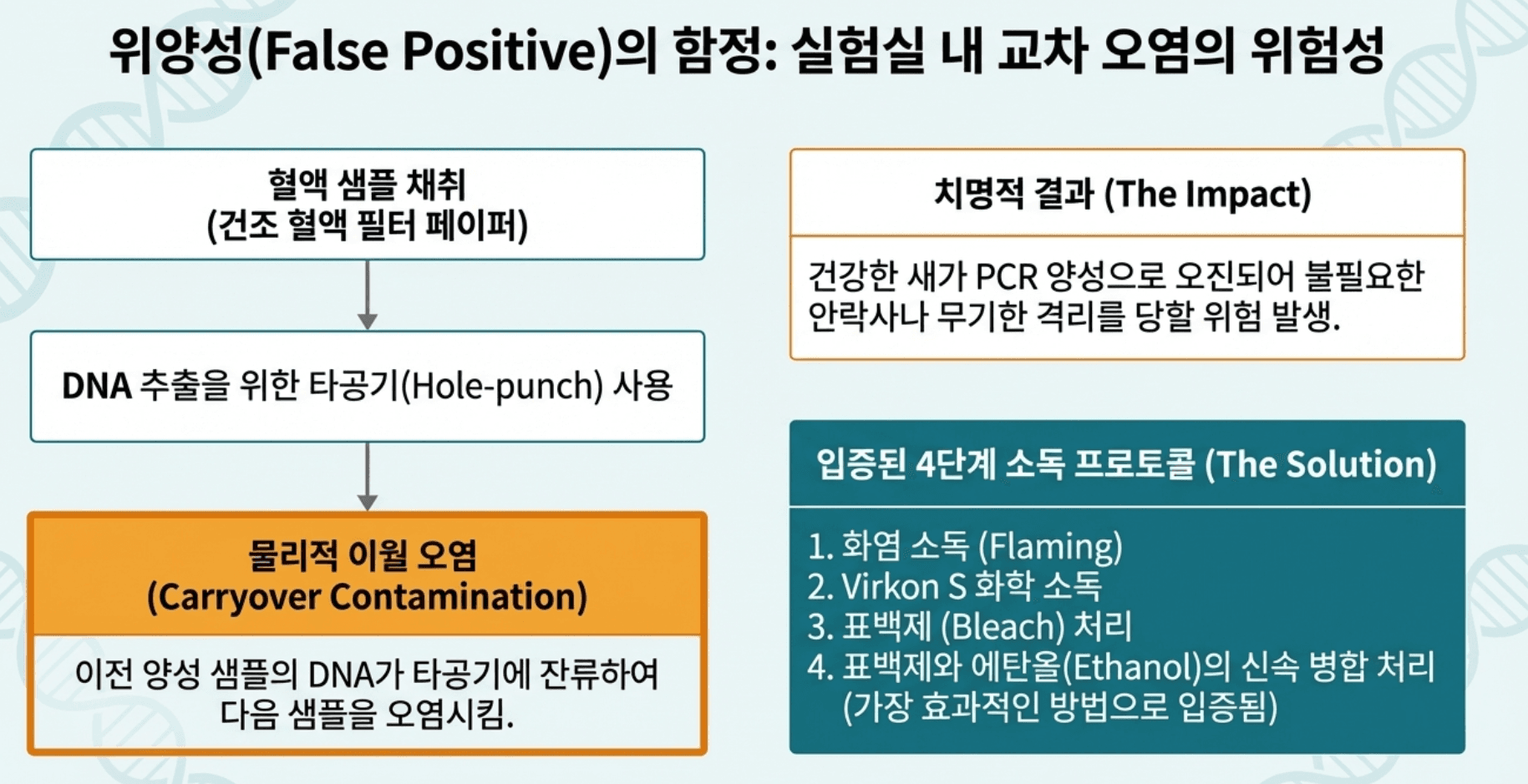
False positives can happen through processes like this. Proper decontamination protocols are important to reduce that risk.
Another thing to keep in mind is viral variation. Some older papers reported cases that could not be detected with the PBFD primers commonly used at the time.
So in practice, it helps to think about testing like this:
- If the result is positive, do not brush it off. Consider isolation and repeat testing right away.
- If the result is negative but the timing of exposure or the clinical signs are still suspicious, consider repeat testing.
In short, you need to be careful about both false positives and false negatives.
Prevention matters more than treatment
As of 2026, PBFD vaccines are generally understood not to be available worldwide in routine practice. Even if something exists, the effect has not been clearly established, and because this is a viral disease, variation remains a concern.
That is why, in real life, things like isolation, hygiene management, and immune status are much more important.
With PBFD, the more important question is not "How do we treat it?" but "How do we prevent it?" and "How quickly can we detect an infected bird?"
If multiple birds live together, or if you are working in a breeding environment, you need to be even more careful.
Once an infected bird appears, it is no longer just about that individual. It can affect the other birds in the same space, the birds using the same equipment, and even future chicks.
Of course, if you suspect PBFD or your parrot simply does not seem to be doing well, it is much better to visit a nearby vet than to rely on a visual check or a rough guess.
You can find nearby clinics through our service, Angmorning. If a clinic is missing, please let us know.
Conclusion
PBFD is probably one of the most familiar disease names in the parrot world.
It is widely known, but at the same time, a lot of people do not actually know it in much detail.
To summarize it briefly:
- PBFD is not just about feather and beak abnormalities
- asymptomatic or atypical cases are possible
- transmission has to be understood together with environmental management
- testing is important, but it should never be interpreted without context
- in the end, early detection and stopping spread matter most
At Naviary, our disease-control principles are:
- Immediately isolate any bird suspected of infection
- If a suspected case appears, perform a full review of the breeding center population, including PCR testing of all birds
- Incinerate or sterilize all items used by the suspected bird
These are the principles we operate by. In a breeding center, a single infected bird can affect other birds and the breeding program as a whole, so preventing spread and protecting the group has to be managed more strictly than care for one individual alone.
And of course, the most important thing is to prevent infection in the first place. That is why prevention remains the top priority in how we operate the breeding center.
In the next article, I’ll cover PDD (Proventricular Dilatation Disease).
References
-
Subir Sarker, Jade K Forwood, Shane R Raidal. Beak and feather disease virus: biology and resultant disease. (2020)
-
Nicolai Johnsen Bonne. Psittacine beak and feather disease: vaccination, haematological response and PCR methodology. (2009)
-
Miloš Vučićević, Ivana Vučićević, Milan Došenović, Marko Ristanić, Nevenka Aleksić, Radmila Resanović, Zoran Stanimirović. Is PBFD symptomatology species specific rather then strain specific? – A case of 8 lovebirds. (2020)
-
Branson W. Ritchie, Christopher R. Gregory, Kenneth S. Latimer, Raymond P. Campagnoli, Denise Pesti, Paula Ciembor, Madeline Rae, Holly H. Reed, Brian L. Speer, Brian G. Loudis, H.L. Shivaprasad, Michael M. Garner. Documentation of a PBFD virus Variant and its Importance to PBFD Testing. (2003)