
 Parrot Blog
Why Foraging Matters for Parrots
A practical look at the core of parrot enrichment. Why the process of searching, shredding, and extracting food matters more than a simple bowl, and which kinds of enrichment tend to reduce problem behaviors more effectively.
 Naviary
Introduction
Up until about ten years ago, keeping a parrot in a cage was pretty much taken for granted in Korea.
"Birds should be kept in cages."
And honestly, in modern homes, cages still matter. If you cannot watch them 24/7, a house is full of hazards for a parrot.
Still, the way people think about companion animals has shifted. More and more guardians try to improve welfare and put real effort into their pets' happiness.
Parrots are no different. These days you hear the word "foraging" everywhere, usually in the context of enrichment.
But a lot of people still think enrichment basically means, "Put some toys in there and let them play."
When you actually read the papers, the point is less about the number of toys and much closer to the structure of behavior. Enrichment is not just about adding objects. It is closer to redesigning how your parrot spends the day.
One thing came up again and again across studies.
Foraging
In other words, increasing the time they spend searching, tearing, pulling out, holding, and processing food.
Enrichment isn't just "something to do"
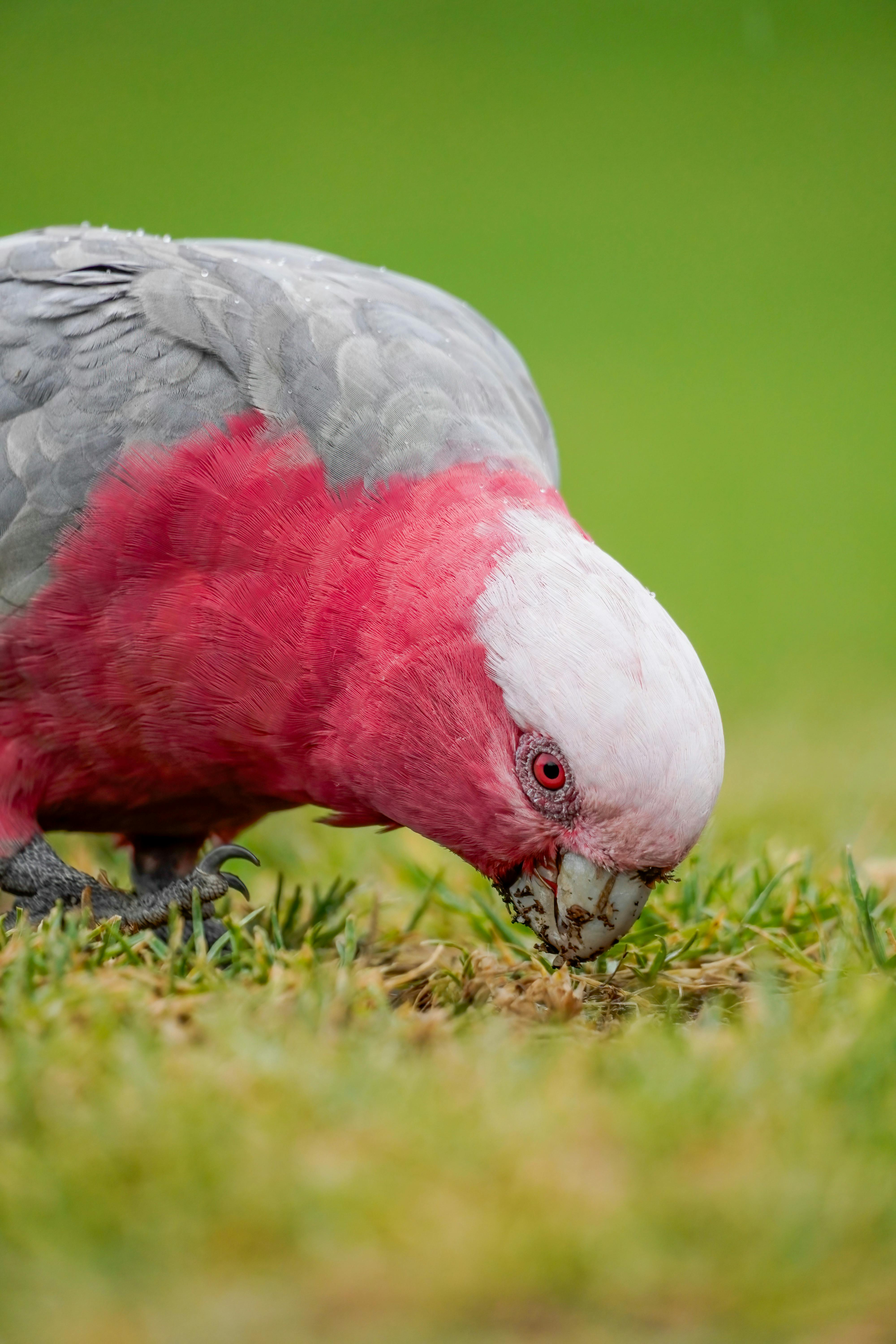
For wild galahs, searching for food is such an important activity that it can take up nearly half the day.
Enrichment is not a trick for keeping a bird busy with constant stimulation.
More accurately, it is about restoring the time for natural behaviors that gets cut far too short in captive environments.
In the wild, adult parrots do not just sit still and receive food.
They fly to find it, flip through the ground, branches, and leaves, choose what to eat, hold food with their feet, crack it with their beak, tear it apart, and move around while eating.
Now think about many homes.
A lot of pet parrots eat straight from a bowl. The whole process can take only a few minutes. Then there is a huge empty stretch of time, and for some individuals, that kind of simplified environment can lead to excessive screaming, cage biting, human-directed biting, feather destructive behavior, and more.
So the core question of enrichment should not start with "What should I add?" It should start with "How much did this bird use their beak, feet, and brain today?"
Why foraging, specifically?
The most consistent message in the papers I read was this:
Giving food and making them work to obtain food are completely different things.
Even if it is the same food, there is a huge difference between:
- putting it in a bowl so they can eat it right away
- making them pull it out from paper, wood, leaves, holes, or boxes
That choice changes how they spend time in the cage.
That time difference matters more than you might think. Parrots are not just animals that "fill their stomachs." They are animals that repeatedly use their beak and feet and keep performing behaviors like searching, choosing, and manipulating as part of getting food.
So it is more accurate to see foraging not as simple "food enrichment," but as enrichment that expands behavior time and stimulates a parrot's brain.
Foraging
How the way they eat changes behavior
Zoos do a lot of research on questions like, "How should we present food to parrots?"
As I mentioned in Chestnut-fronted Macaw Nutrition Guide: From Wild Diet to Scientific Feeding, offering food whole rather than finely chopped increased the time they spent eating, and they also ate more.
Another study looked at environmental enrichment for Lear's Macaws in a Brazilian zoo.
When the birds were given hazelnuts carefully wrapped in banana leaves, hard coconut shells, and paper boxes packed with rough grass and coconut fiber, their behavior changed.
They spent less time around the food bowl and much more time interacting with the paper box. Allopreening also increased.
In other words, enrichment is not just "something to distract them from boredom." It is a tool that can improve quality of life itself.
Not all foraging is equally good
A study in an Australian zoo compared five conditions for parrots showing problem behaviors: no foraging, cucumber slices, fresh grass, a baffle cage, and a millet disk.
Across the board, foraging methods increased foraging time, meaning the time spent searching for and working on food.
But the clearest reductions in problem behaviors were linked to the grass and the millet disk.
It was not simply that the birds liked eating. It was the work itself: pulling up grass roots one by one, using tongue and feet to handle leaves precisely, and spending far more time picking millet seeds out of the firm, sticky texture of a millet disk made from flour, water, and millet.
The results suggest enrichment does not work just because "there is food inside." The structure needs to require sustained tearing, rummaging, extracting, and manipulating for it to work better in practice.
- enrichment they can finish in one easy go
- enrichment that ends in a few seconds
- enrichment that barely uses beak and feet
From the bird's point of view, those are basically just treats.
So from a guardian's point of view, a flashy and colorful menu is not automatically foraging.
Individual differences
Even birds in the same cage responded differently. With the exact same foraging setup, one individual might become more active and show fewer abnormal behaviors, while another might show very little change.
That is why your observation matters most. For each bird, you want to learn:
- what they keep chewing and playing with for a long time
- what they give up on quickly
- what materials they prefer
That kind of information helps you build foraging setups that actually work for your bird.
Enrichment and training are not separate things
One of the papers I read gave me a new perspective.
It was the idea that training and enrichment are not totally separate.
If you think about it:
- training is arranging the environment and consequences so a desired behavior happens voluntarily
- enrichment is designing the environment so natural behaviors happen more often
In the end, both are tools for shaping behavior.
So rather than seeing enrichment as "toys," I think it is cooler, and more accurate, to see it as environmental design that helps a parrot choose good behaviors on their own.
If you watch programs like There Is No Bad Dog, most problem behaviors are improved not by punishment, but by guiding the animal toward different behaviors until change happens naturally. The same idea applies broadly across animals.
When you train, try designing a sequence of choices your parrot can make on their own.
In actual research settings, the essence of enrichment is bringing out natural behaviors so voluntary, cooperative behavior can emerge.
At the San Diego Zoo, keepers trained a diabetic drill, a kind of primate, to choose insulin injections voluntarily instead of being forced. Giving animals that kind of choice can drastically reduce stress, and it repeatedly shows that animals are happier when they get to act.
Alex the African Grey's language learning was similar. Instead of forcing memorization, researchers created an environment where words had meaning he could refer to, and learning happened naturally through reinforcement.
You can read more about that in my earlier post, Why Can Parrots Mimic Human Speech? Alex Research and a Modern Neuroscience Summary.
Enrichment you can try at home
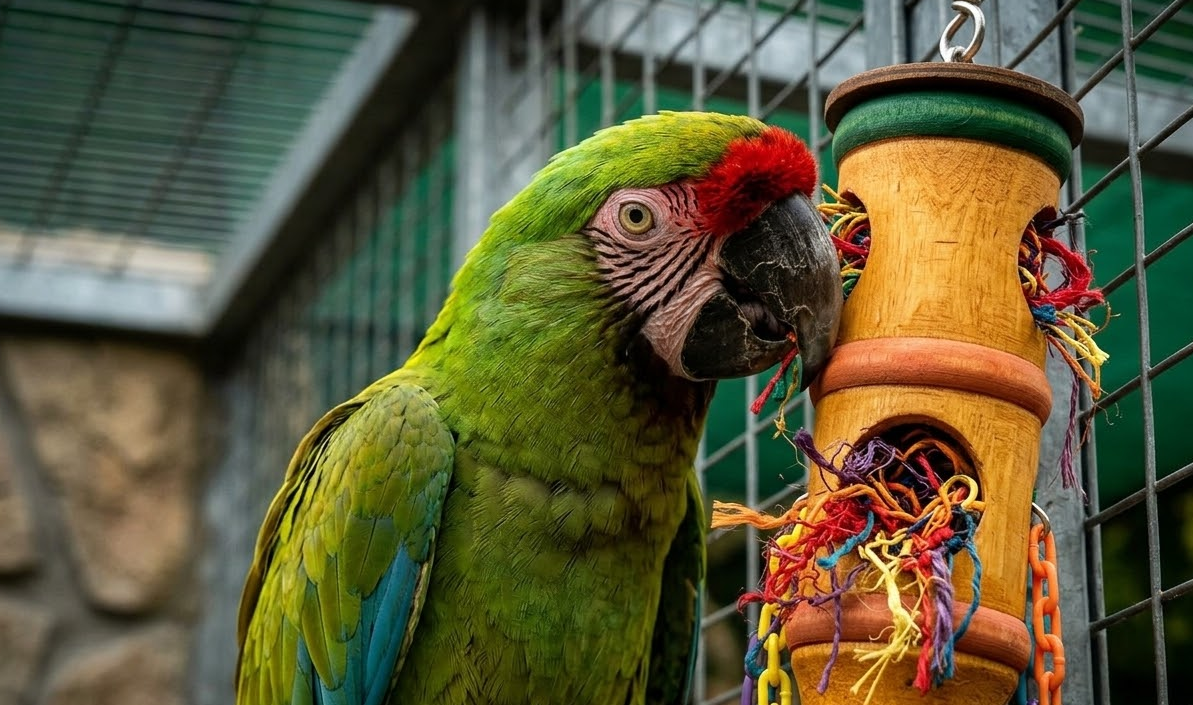
A foraging toy. You can fill it with paper strips, seeds, and more.
1. Don't just hide food, design it so they must extract it
It is better than simple hiding when the structure makes your parrot actually dig, tear, shred, break, and pull food out.
For example:
- put fruit inside a paper cup
- mix food with paper inside a box
- make them pull grains out through holes
The key is not only "They found it." The key is designing what they do after they find it.
2. Don't only chop food small, let them hold and tear it
Parrots are not beak-only animals. The process of holding food with their feet is important too.
So when you can:
- do not mince vegetables too finely
- do not rely only on tiny pellets
- offer food in larger pieces
- hang it up or clip it so they have to tear it off
At Naviary, I never mince food for the parrots we raise. Of course, larger pieces have a downside. Sometimes big chunks fall to the cage floor after just one bite, and they end up getting tossed... which does hurt a little... :(
Still, when I think about the birds' happiness, I do not regret it at all.
I understand the parent-like heart many guardians have, wanting their parrots to eat comfortably and finish everything, but please think a little more about your parrot's happiness.
3. Increase difficulty step by step
If you make it too hard from the start, your parrot might give up.
Enrichment is not an IQ test, so early success matters.
- try putting food into paper that is only half closed
- then wrap it fully in paper
- next, use a box that is harder to tear, with paper and food mixed in
- add multiple layers inside the box so they have to tear through layers to find food
Raising the difficulty gradually like this works well. Beyond these ideas, try finding your own methods too. If you have a great one, please share it with me.
4. Don't only rotate, record too
At Naviary, we take records very seriously. That is also why we built our breeding system digitally.
Recording helps you level up faster and reduce trial and error.
Enrichment records are also what make individual differences visible. If you track which bird likes what, what they quit quickly, and what behaviors show up, you also end up learning your parrot more deeply.
5. Keep it safe
Many everyday human items contain materials that are not good for animals. With parrots, the risk can be even higher because they use their beak and tongue so actively.
Materials must be non-toxic, safe if swallowed, and designed so beaks and feet will not get stuck. Remove wet or contaminated materials right away.
Good enrichment is not about making things so complex that they give up, or chasing risky thrills.
You only need to meet one goal: safe, long-lasting interaction.
Enrichment isn't a cure-all
Enrichment helps with problem behaviors, but it is not a silver bullet.
If problem behaviors are severe, self-harm is clear, or activity has noticeably dropped, a vet visit is the better move.
You can find nearby clinics through our service, Angmorning. If a clinic is missing, please let us know.
Conclusion
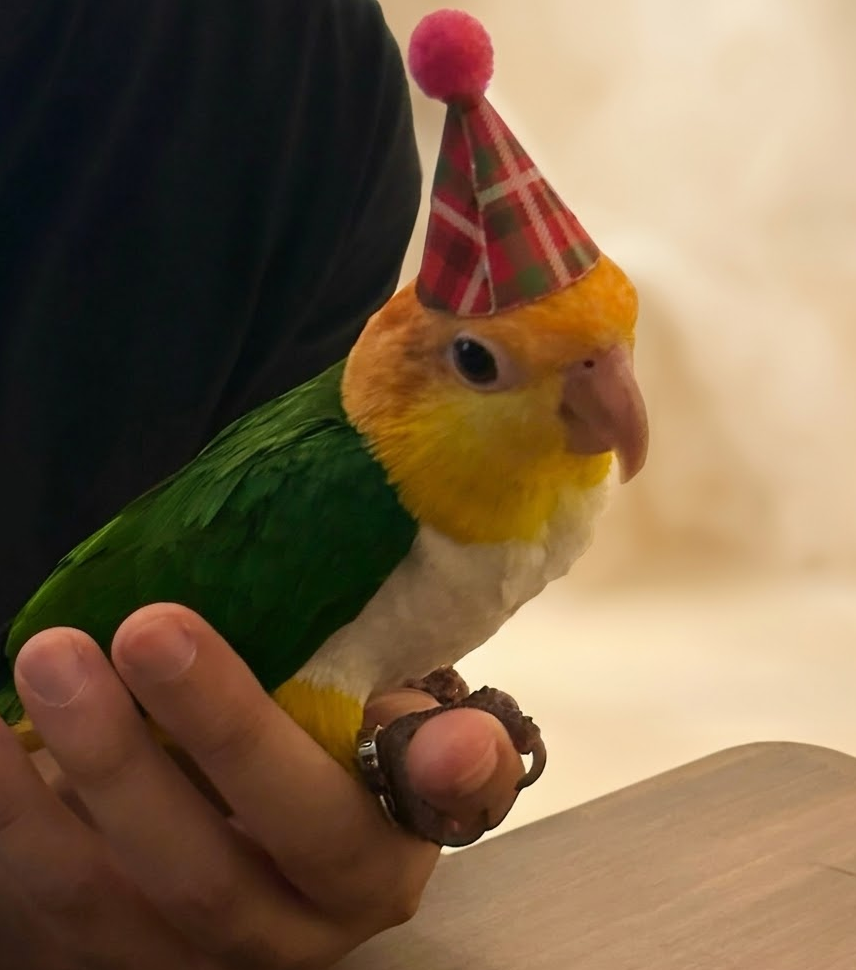
Junbae, one of Naviary's adorable parrots
Reading these papers made me reflect a lot, and I learned a ton from them.
The core of parrot enrichment is not good food or fancy fruit. It is helping parrots keep natural behaviors going for a long time.
An expensive toy is not automatically enrichment.
- long searching
- long tearing
- heavy use of feet, beak, and brain
- a structure that fills the day with richer, more meaningful time
That is what good enrichment looks like.
At Naviary, I also want to keep testing different options for each bird, recording what works, and getting more precise about better enrichment.
Making a parrot happy is not only about feeding them well. It is about giving them the chance to act like themselves and giving that happiness back to them.
References
-
Fernandez, E. J., & Martin, A. L. Animal Training, Environmental Enrichment, and Animal Welfare: A History of Behavior Analysis in Zoos.
-
Azevedo, C. S., Caldeira, J. R., Faggioli, A. B., & Cipreste, C. F. Effects of different environmental enrichment items on the behavior of the endangered Lear's Macaw. (2016)
-
Fangmeier, M. L., Burns, A. L., Melfi, V. A., & Meade, J. Foraging enrichment alleviates oral repetitive behaviors in captive red-tailed black cockatoos. (2020)
-
Coulton, L. E., Waran, N. K., & Young, R. J. Effects of foraging enrichment on the behaviour of parrots. (1997)