
 Parrot Blog
Why Can Parrots Talk? Alex the Grey Parrot and Modern Neuroscience
Do parrots really understand what we say? Exploring parrot intelligence and vocal learning through Alex the Grey Parrot and recent neuroscience research.
 Naviary
Introduction
Don't you ever wonder when you see a parrot talking?
"Do they actually know what they're saying?" or "How on earth do they manage to mimic us?"
These questions lead to some incredibly fascinating research. Today, we'll dive into why and how parrots can talk, based on the legendary studies of Alex the African Grey and the latest findings in neuroscience!
The Alex Studies: The Difference Between "Mimicking" and "Knowing"
There's a famous decades-long study by researcher Irene Pepperberg and her partner, Alex the African Grey.
Alex did more than just mimic sounds; he could verbally answer questions about what color an object was, its shape, or even quantity. You might think, "Wasn't he just trained?" but the most important part of the research was the conditions under which this became possible.
It's not just about "Alex was a genius parrot!" It's about what kind of input made this level of understanding possible.
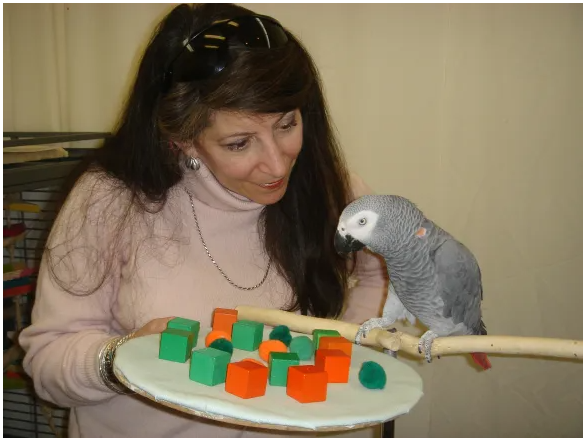
Alex and Irene Pepperberg (Source: The Alex Foundation)
The training method Pepperberg used is called the Model/Rival (M/R) technique. The name sounds a bit technical, but the concept is simple.
Two people interact in front of the parrot. One person asks a question like "What color is this?" while holding an object, and the second person answers "Red." If the answer is correct, they are praised and given the object. If it's wrong, the object is taken away.
The parrot watches this interaction and naturally picks up the context of "If I say that word, I get that object."
Pepperberg emphasized three key elements:
- Referentiality: Words must point to something specific.
- Functionality: Saying those words must actually change something in the environment.
- Social Context: Learning happens much better through interaction than through mere repetition.
Without these three, even Alex couldn't use words "referentially." In other words, simply playing sounds to a parrot doesn't mean they'll learn to speak in a meaningful way.
Neuroscience: How Does a Parrot's Brain Process Sound?
Recent studies are looking for the "how" inside the brain.
A 2025 study published in Nature observed how neuron activity is organized in the AAC (arcopallium)—a forebrain region—when budgerigars (lovebirds) vocalize. The key findings can be summarized into three points:
-
The AAC organizes sound features like a map. AAC neurons were observed to be systematically arranged based on the timbre or frequency characteristics of sounds.
-
It makes modifying or combining sounds easier. This structure allows parrots to easily combine or transform existing vocal patterns into new sounds. It explains at a neural level why parrots don't just copy—they improvise.
-
This principle wasn't observed in Zebra Finches. Even though both are "vocal learning birds," it seems parrots have a unique organizational principle that puts them closer to mimicking human speech.
The Unique Structure of the Parrot Brain: Core + Shell
So, why are parrots specifically so good at this?
One study compared vocal learning circuits more broadly and found that parrot brains have a unique singing (vocal) system composed of a core and a shell.
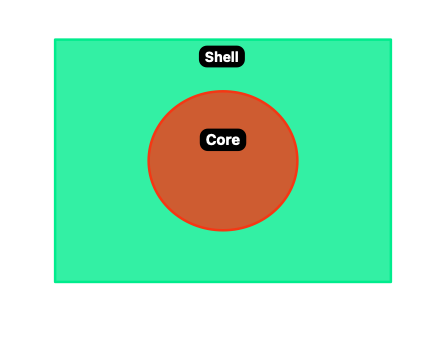
Structure of the Parrot Brain
The Core
The core resembles the basic circuits found in other vocal learners like songbirds (finches, wrens) and hummingbirds.
It's divided into two main pathways: one for producing and outputting vocal movements, and another for learning and refining them. Simply put, one is for "making sound" and the other is for "polishing sound."
This circuit is well-studied in songbirds, and the parrot core shares this similar foundation. This means parrots didn't evolve a completely different engine; they built upon the common foundation of avian vocal learning.
The Shell
The shell is an expanded circuit found only in parrots. it wraps around the core nuclei like an outer layer.
Even in the kea, a primitive parrot, traces of a very early form of the shell have been reported alongside the core. This suggests that the parrot's vocal learning system took root a long time ago.
What's fascinating is that the shell isn't a single uniform area. The research distinguishes two layers:
-
Inner Shell This part is active during vocalization. It works as part of the "sound production circuit" alongside the core.
-
Outer Shell This area overlaps with regions that respond to general (non-vocal) movement.
This outer shell is crucial because it means the vocal circuit is connected to a broader motor (movement) circuit. This provides the structural basis for why a parrot's speech isn't just a "sound-making action" but can be linked to a wider context of behavior.
The relative sizes of the core and shell vary by species, and researchers believe these differences could be linked to variations in vocal ability or cognitive traits between species.
Individual Differences: A Survey
Data comparing mimicry repertoires through companion parrot surveys shows significant differences between species and individuals.
On average, among various parrot species, the African Grey tends to have the largest repertoire of words or sounds. However, individual differences within the same species are huge. Some are incredible talkers while others stay quiet, a pattern clearly visible in the data.
| Parrot Species | Words Mimicked | Sounds Mimicked | Sentences Mimicked |
|---|---|---|---|
| African Grey | 59 | 22 | 24 |
| Umbrella Cockatoo | 33 | 5 | 18 |
| Blue-fronted Amazon | 27 | 6 | 16 |
| Budgerigar (Lovebird) | 26 | 7 | 13 |
| Yellow-headed Amazon | 26 | 7 | 9 |
| Sulphur-crested Cockatoo | 25 | 4 | 18 |
| Blue and Gold Macaw | 24 | 6 | 12 |
| Quaker Parrot | 24 | 6 | 11 |
| Eclectus Parrot | 22 | 4 | 12 |
| Yellow-naped Amazon | 22 | 5 | 9 |
| Ring-necked Parakeet | 21 | 6 | 7 |
| Galah Cockatoo | 17 | 4 | 10 |
| Senegal Parrot | 13 | 12 | 7 |
| Yellow-crested Cockatoo | 13 | 4 | 6 |
| Cockatiel | 13 | 5 | 4 |
| Green-cheeked Conure | 9 | 3 | 4 |
| Pacific Parrotlet | 6 | 2 | 3 |
| Sun Conure | 5 | 2 | 2 |
| Lovebird (Agapornis) | 3 | 7 | 2 |
Conclusion
The Alex studies teach us that for meaningful speech to develop, we need more than just repetition—we need interaction, reference, and functionality. Neuroscience shows us exactly why this is possible.
The parrot brain has circuits that systematically organize sound features, making them ideal for transforming and combining sounds. The core and shell structure provides the larger framework for this unique ability.
So, if you ask "How can I help my parrot talk?" the research points in a consistent direction. Instead of just making them memorize words, create situations where they can understand the meaning. Link rewards to what the word refers to, and focus more on the context of the interaction than the sheer volume of sound playback.
Ultimately, teaching a parrot to talk isn't about planting words in their head; it's about creating an environment where speech can happen naturally.
References
- Pepperberg, I. M. Cognitive and Communicative Abilities of Grey Parrots. (2002)
- Chakraborty, M., et al. Core and Shell Song Systems Unique to the Parrot Brain. (2015). PLOS ONE.
- Yang, Z., & Long, M. A. Convergent vocal representations in parrot and human forebrain motor networks. (2025). Nature.
- Benedict, L., et al. A survey of vocal mimicry in companion parrots. (2022). Scientific Reports.