
 Parrot Blog
Naviary's Parrot #1 - Chestnut-fronted Macaw
Introducing the Chestnut-fronted Macaw available at Naviary. We've summarized the characteristics and care points of this species, which possesses all the charm of a medium-sized Macaw.
 Naviary
Introducing Naviary's parrots
Introduction
Introducing the first species prepared by Naviary.
While preparing the breeding center, the biggest consideration was "which species to specialize in." After synthesizing market research and various situations, one of the final species chosen was the Chestnut-fronted Macaw.
The Chestnut-fronted Macaw is the largest of the six small-to-medium Macaw species commonly called Mini Macaws
Although less known compared to large Macaws, it is a species that allows you to fully experience the charm of a Macaw even in a smaller space.
Basic Information
Scientific Name and Classification
- Scientific Name: Ara severus
- Common Name: Chestnut-fronted Macaw
- CITES: Appendix II (Documentation required)
- Origin: South America (Brazil, Bolivia, Peru, etc.)
Physical Characteristics
- Size: Approximately 45cm
- Weight: Approximately 300~400g
- Lifespan: 30~50 years
Appearance
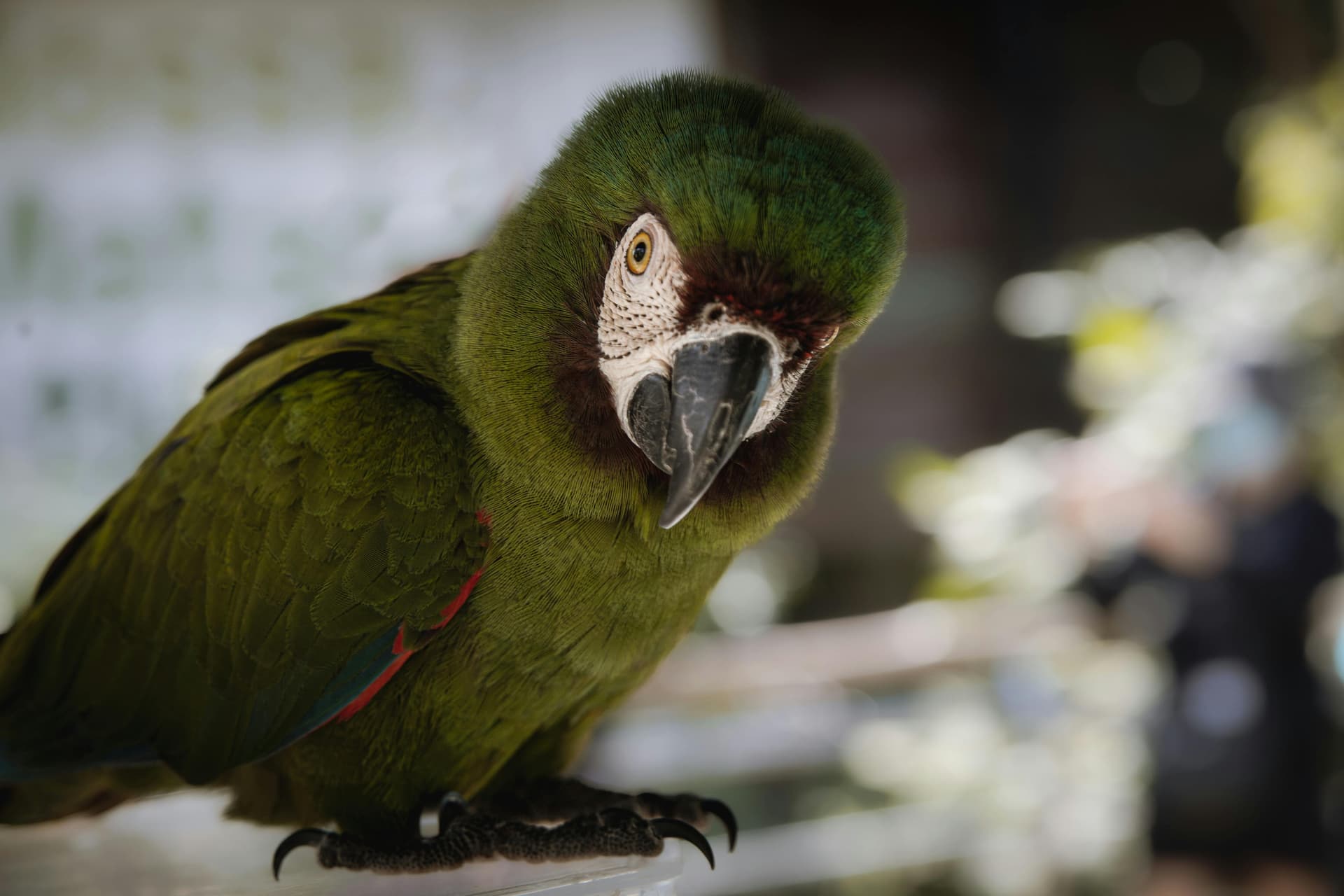
Adult Chestnut-fronted Macaw
The Chestnut-fronted Macaw has overall glossy green feathers. It is characterized by the dark chestnut feathers on its forehead and under the chin, which gave the species its name.
It has iridescent blue feathers on top of its head and vivid red feathers on the edges of its wings. The tail feathers are blue and red underneath, shining beautifully when in flight.
A unique feature that distinguishes it from other Macaws is the fine line of black feathers surrounding the eyes. The beak and feet are gray, and the eyes are a beautiful golden color.
Distinguishing between males and females is impossible based on appearance alone and requires DNA testing or surgical sexing.
Why the Chestnut-fronted Macaw?
While preparing the breeding center, we reviewed several species. The reasons we chose the Chestnut-fronted Macaw are as follows:
1. A Macaw that can be kept in an apartment
Large Macaws like the Blue-and-gold (also known as Blue-and-yellow Macaw!) or Scarlet Macaw take up a lot of cage space and have considerable noise levels, which can be a burden for keeping in a small apartment.
On the other hand, the Chestnut-fronted Macaw is more than half the size of large Macaws, so the noise is proportionately lower, and it can be sufficiently kept in a smaller space. A cage size around BC-301 is suitable for them.
2. Easier difficulty compared to large Macaws
Large Macaws are strong and have many tricky aspects. Chestnut-fronted Macaws are relatively easier in comparison.
Their beak strength is relatively weaker compared to large Macaws, making them manageable, and their personality is comparatively gentle.
Of course, "easier" is relative to large Macaws (laughs). Compared to small parrots, they are much stronger and more demanding, but they are a great option for those who haven't experienced Macaws before.
3. Rarity in the domestic market
There are almost no places in Korea that specialized in providing Chestnut-fronted Macaws. Usually, they come from origins that are hard to know or imported one or two at a time as individuals.
In these cases, they are easily exposed to the risk of disease. Also, imported individuals, if brought from unverified places, are prone to disease when their immunity is weakened.
Check out how to find a safe adoption source in the How to Avoid Parrot Scams: From CITES Verification to Health Checks post.
Naviary aims to reduce these risks and provide healthy Chestnut-fronted Macaws equipped with everything through scientific and systematic breeding utilizing IT technology:
- Clear lineage management
- Thorough health checkups (4 major diseases)
- Systematic socialization process
- Complete documentation
Personality and Characteristics
Personality
If socialized properly from a young age, Chestnut-fronted Macaws can become ideal companion birds. Especially the socialization process during the "Weaning" stage is extremely important.
Naviary strives to make them ideal companion birds through behavioral enrichment, calling training, and socialization education during this weaning process.
As Macaws, Chestnut-fronted Macaws are highly active, highly intelligent, and very curious. Because they are energetic, if boredom persists for a long time, problem behaviors such as self-mutilation, anxiety, or destructive behavior may occur.
Also, because they are social animals that live in flocks, they need time to interact regularly. This is true for almost all parrots.
In particular, they like puzzles or games and tend to be obsessed with shiny objects. Be sure to put away jewelry. While you're looking away thinking "Isn't this pretty?", your earrings will already belong to that friend lol.
Bluffing Stage
Like other parrots, Chestnut-fronted Macaws go through a "bluffing stage," often called "Parrot Adolescence."
A time may come when you think, "The baby that was eating from my hand until yesterday is suddenly attacking?"
During this period:
- Suddenly lunging
- Biting or pecking
- Hissing
- Refusing interaction
They exhibit such behaviors and try to look like small dinosaurs.
This is a stage that occurs in almost all parrots, and the intensity may vary by individual. Those who have interacted well will likely pass through it quickly.
Talking and Sound
The Chestnut-fronted Macaw is one of the parrots with excellent talking ability. Their pronunciation is clear, and they can command a fairly wide vocabulary.
Similar to other Macaws, Chestnut-fronted Macaws sometimes scream. They mainly call in the morning and at sunset.
They are smart birds, so when correcting wrong behavior, it's better to ignore them rather than scolding.
Health
The Chestnut-fronted Macaw is a relatively hardy species. While there is a perception in Korea that they are a bit weak, similar to Hans Macaws, that's mostly because they have been raised in smuggling or poor environments.
Nevertheless, you must be very careful about the following diseases as they are highly contagious and have high mortality rates!
- PDD (Proventricular Dilation Disease)
- Especially fatal to Macaws!
- Vomiting, digestive stasis, dehydration, loss of energy
- PBFD (Psittacine Beak and Feather Disease)
- Beak and feather disease
- Pacheco's Disease (Avian Herpesvirus Infection)
- Lethargy, loss of appetite, diarrhea, decreased activity
- APV (Avian Polyomavirus)
- Loss of appetite, feather deformities, diarrhea, crop stasis
- Psittacosis (Parrot Fever)
- Chlamydiosis, inflammation, zoonotic disease; treatable since it's a bacterial disease.
I'll post more detail about diseases next time :)
Diet
In the wild, they eat seeds, nuts, fruits, leafy greens, flowers, etc., and sometimes consume minerals from clay.
When keeping them at home, pellets should be the main diet, but you should vary the food by additionally providing various fruits, vegetables, and grains.
The reason for choosing pellets as the main diet is one: nutritional balance! If your parrot really eats everything well without leaving anything, it's okay for the guardian to personally balance the nutrition and feed them.
I will post separately about foods that are good to provide additionally and foods that should not be fed :)
Summary
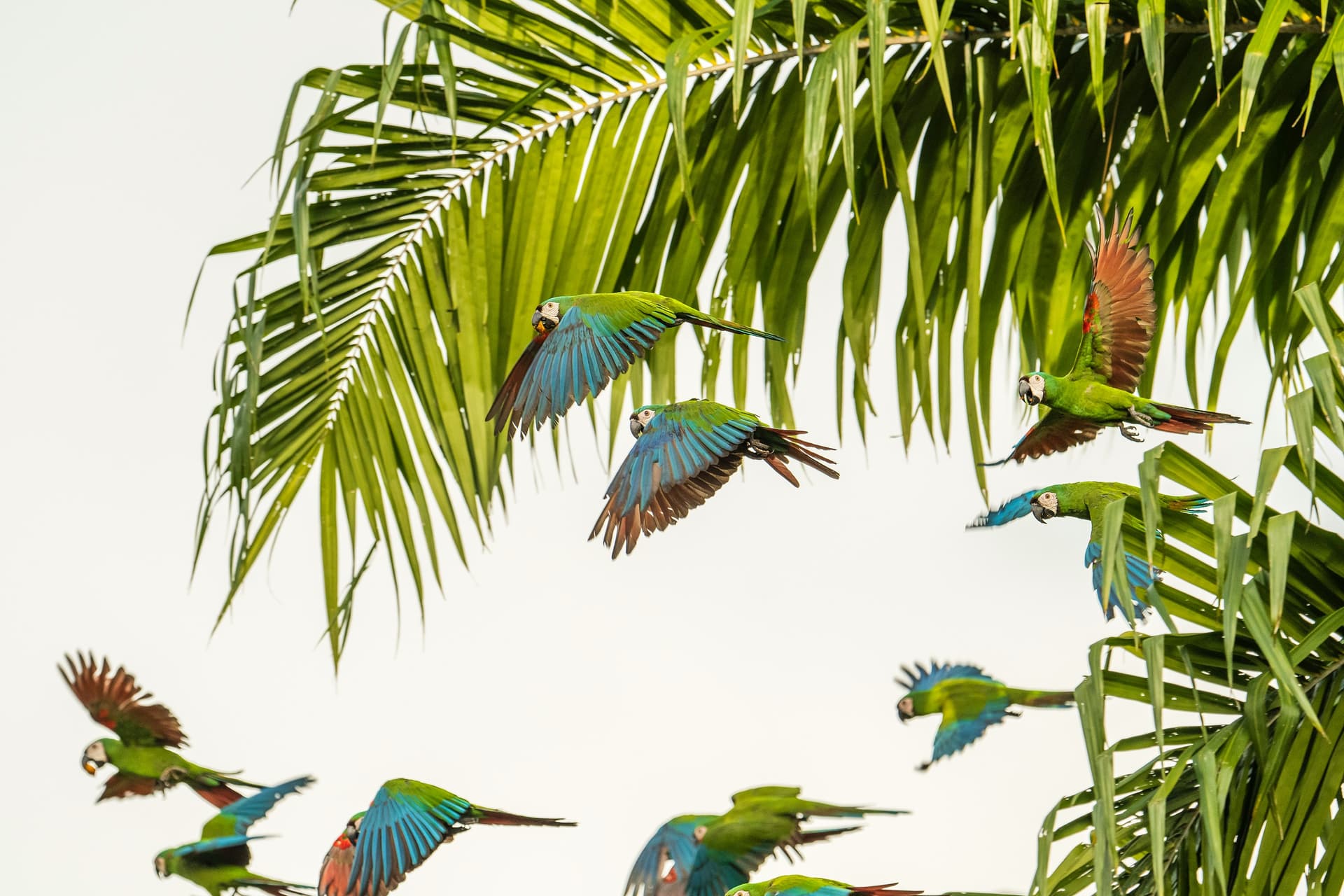
Wild Chestnut Macaw flock
The Chestnut-fronted Macaw is small but possesses all the charm of a Macaw. If you prepare sufficiently and adopt one, they will be a wonderful companion for over 30 years.
If you want to know more about how to raise a Chestnut-fronted Macaw at Naviary, feel free to contact us at any time!
In the next post, I'll cover Galah Cockatoo, another major species of Naviary!