
 Parrot Blog
A Guide for Prospective Parrot Owners, Part 2: Preparing for Your Parrot
Learn how to prepare your home before bringing a parrot home, from choosing a cage and perches to pellets, toys, a travel carrier, and basic health-care essentials.
 Naviary
A Guide for Prospective Parrot Owners
Introduction
"I want to adopt a parrot, but where should I begin?"
It is one of the questions we hear most often from prospective parrot owners.
People say that special connections happen in an instant. When it comes to adopting a parrot, though, I think the saying “opportunity favors the prepared” is a better fit.
Parrots are long-lived animals. Being properly prepared gives you the best chance of sharing a long, healthy life together.
Preparing for a parrot is quite different from preparing for a dog or cat. There is more to consider than many people expect, from cage size and diet to household safety.
Rather than trying to buy every toy and accessory at once, start by creating the basic environment your parrot needs to live safely.
In the previous article, we looked at the adoption process. This time, we will explore what kind of environment you need to prepare before bringing a parrot home.
Every Parrot Needs a Different Environment
First, learn about the species and individual bird you plan to adopt.
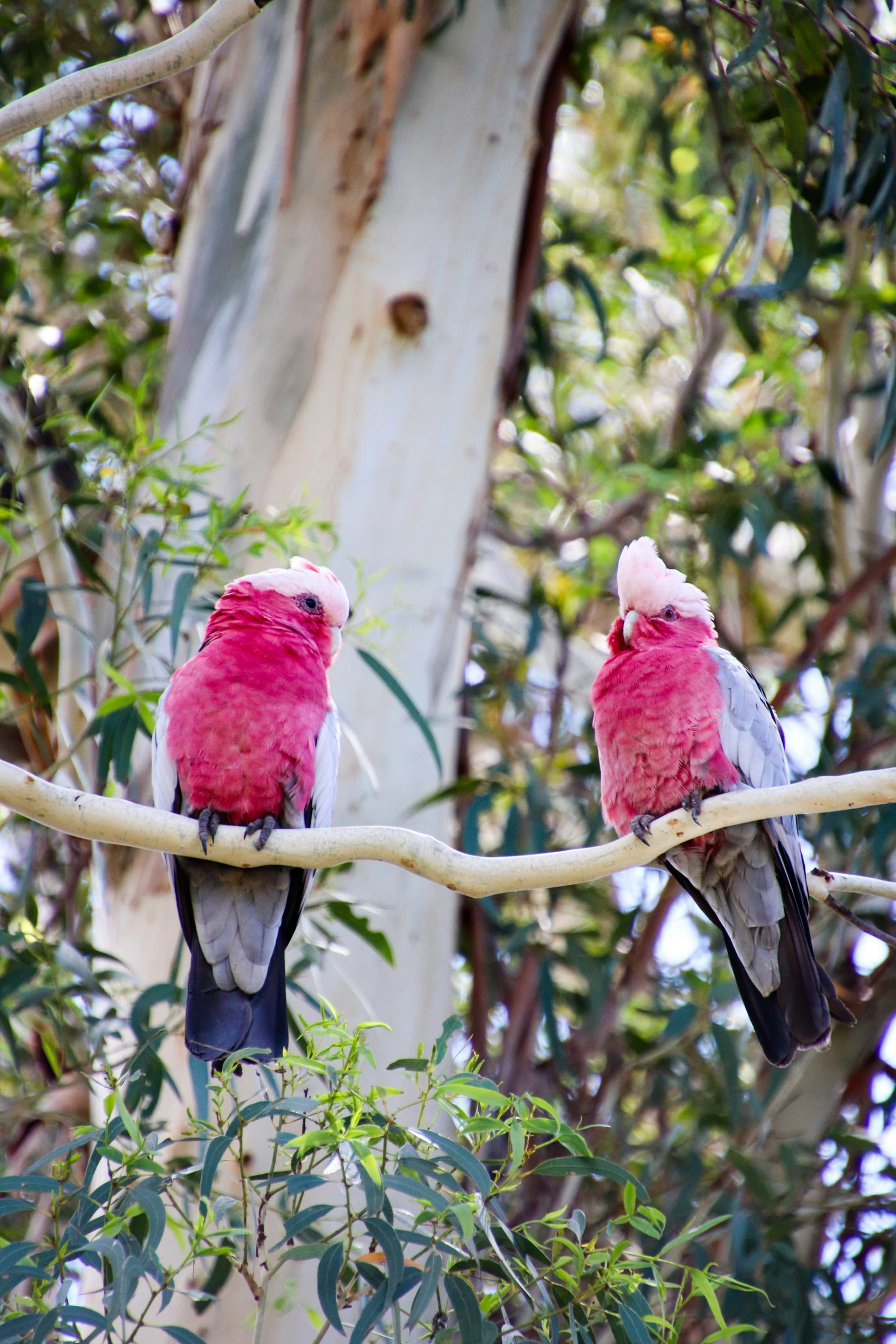
Smaller species such as budgerigars and lovebirds, medium-to-large species such as Galah cockatoos and chestnut-fronted macaws, and large species such as sulphur-crested cockatoos, scarlet macaws, and blue-and-gold macaws all need different cage sizes, perch diameters, and living environments.
Even within the same species, a parrot’s needs can vary depending on its age, health, flight ability, and activity level.
That is why you should not choose supplies solely because they are labeled “for small birds” or “for medium birds.”
Cage
A cage is essential because it gives your parrot a safe place to rest.
A parrot can be accidentally crushed if it sleeps in a person’s bed, and it can be injured in many other ways, including being caught in a door. A cage is therefore an essential part of living safely with a parrot.
It is important to help your parrot recognize its cage as a safe place to live and rest.
Size
The right cage size depends on both the parrot species and your lifestyle.
Here, I will give only a brief overview of how large a cage should be. We will cover cage selection in greater detail in a future article.
Let’s look at it by lifestyle.
You Are Home All Day and Can Spend Most of It With Your Parrot
In this situation, your parrot may spend much of the day outside the cage in your shared living space, with the cage serving mainly as a place to sleep.
Even then, the cage should offer more than just enough room for the bird to fit inside. It should provide enough space for your parrot to settle comfortably.
You may also need to go out unexpectedly or be away for several hours. A cage that is too cramped can be stressful in those situations, so it is best to prepare for the unexpected.
You Do Not Commute, but You Still Need Time to Yourself
You need a cage that allows your parrot to move around, stretch its wings, exercise, and access food and water.
There should also be enough room to hang or place toys without overcrowding the cage.
You Commute or Are Frequently Away From Home
If your parrot will spend a substantial amount of time in the cage, larger is better. Ideally, it should be large enough for the bird to fly in, or at least spacious enough for meaningful physical activity.
Size is not the only consideration, however. If your parrot can fit its head between the bars, it may become trapped. Always choose bar spacing that is appropriate for the species you plan to adopt.
If you are unsure, feel free to contact us.
Cage Materials
Cages are available in several materials, but most use either metal bars or clear panels.
For a straightforward comparison, we will divide them into the following categories:
- Clear-panel cage: A cage whose walls are made primarily from transparent panels
- Stainless steel cage: A cage whose bars and main frame components are made from stainless steel
- Powder-coated cage: A medium-to-large cage with powder coating applied over a heavy steel frame
- Lightweight wire cage: A lightweight wire-mesh cage commonly sold as a flight cage
Names and manufacturing methods vary between sellers. Do not rely on the product name alone—check the actual materials and surface treatment as well.
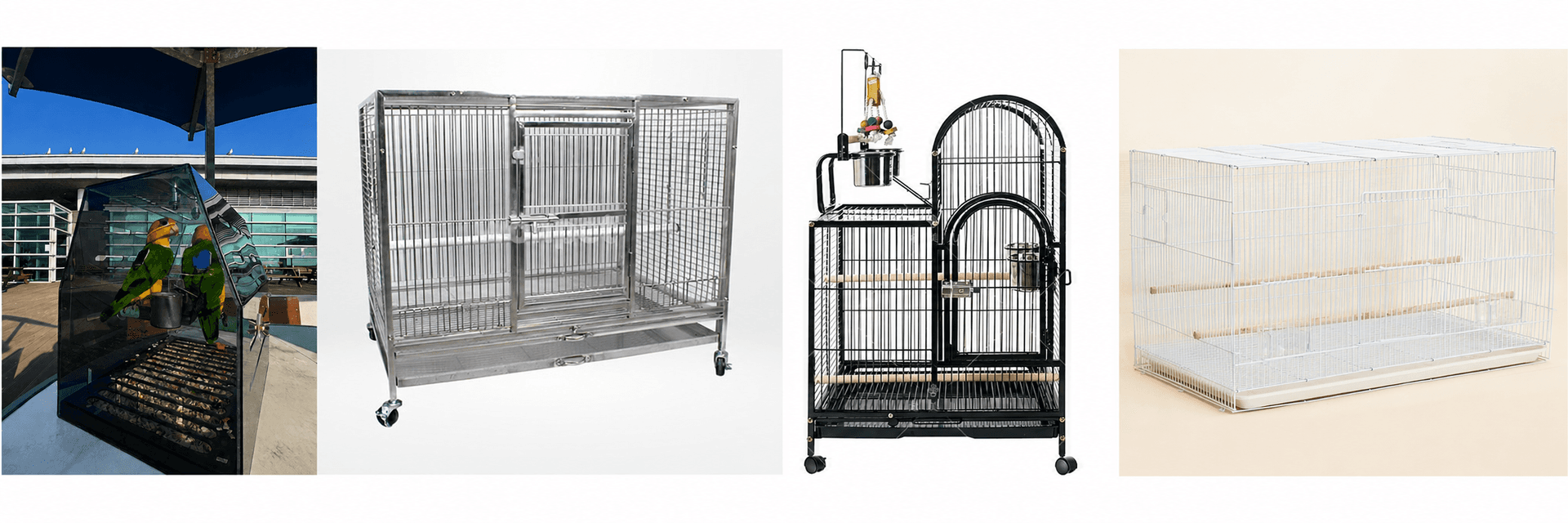
From left: clear-panel, stainless steel, powder-coated, and lightweight wire cages.
Clear-Panel Cage
A clear-panel cage is made with transparent plastic panels.
Advantages
Because the cage is transparent, you can observe your parrot without an obstructed view. With no wire mesh blocking your sight, it is easier to monitor the bird’s behavior, droppings, and food intake without opening the door.
The panels also help contain seed hulls, feathers, water droplets, and other debris. Parrots tend to keep their living space clean and may pass droppings beyond the edge of the cage, so clear panels can help contain the mess.
The smooth panels are easy to wipe clean and reduce the risk of a foot or head becoming trapped in gaps or openings. This type of cage may also be worth considering if someone in the household has allergies or wants to reduce the amount of airborne feathers and dust.
Disadvantages
The greatest disadvantage of a clear-panel cage is ventilation.
Because most sides are enclosed and air can pass only through a limited number of openings, airflow is more restricted than it is in a wire cage. Without adequate ventilation, odors, moisture, and contaminants can build up inside, so careful management is essential.
The transparent panels may also provide fewer places to secure perches and toys. Check that the cage has enough suitable mounting points before buying it.
A clear-panel cage can heat up more quickly than a wire cage in direct sunlight. It should not be left in a hot or sunlit location for extended periods.
Stainless Steel Cage
A stainless steel cage has bars and major frame components made from stainless steel.
Several grades of stainless steel are available, but 304 stainless steel is commonly used.
Advantages
The greatest advantage of a stainless steel cage is durability.
Unlike a typical painted steel cage, there is little risk of a coating peeling away. Stainless steel also resists water and moisture, which lowers the risk of corrosion. Because it does not break easily, it is an excellent option for parrots with powerful beaks.
There is no coating for the parrot to chew off. Food residue is also easy to remove, and the surface is relatively easy to clean and disinfect.
Disadvantages
The main disadvantage of a stainless steel cage is its price. It generally costs more than a lightweight wire or powder-coated cage of the same size.
It is also heavy, which can make assembly, movement, and cleaning more difficult. Wheels can help, but thresholds and uneven flooring can still make the cage difficult to move.
A product may be advertised as a “stainless steel cage” even when connectors, screws, or other components are made from different metals. Check whether any of these parts are accessible to the bird.
Polishing residue may also remain on stainless steel after manufacturing and may need to be removed before the cage is used.
Powder-Coated Cage
A powder-coated cage is made by applying powdered paint to an iron or steel frame and curing it with heat.
In South Korea, this finish is common on medium-to-large cages and dome-top cages.
Advantages
Powder-coated cages offer a good balance between price and durability.
They are generally more affordable than stainless steel cages while providing a thicker, sturdier frame than lightweight wire cages.
Powder coating also creates a more even and relatively durable finish than ordinary liquid paint, so it tends to last longer than the finish on a conventionally painted wire cage.
Disadvantages
A hard powder-coated finish is not indestructible.
If a parrot repeatedly chews the same area or the cage is frequently knocked while being moved, the coating can crack or peel. If moisture reaches the exposed metal beneath it, rust can develop.
Inspect areas that the beak touches frequently—such as doors, locks, and the space around food bowls—on a regular basis.
Lightweight Wire Cage
A lightweight wire cage is often sold in South Korea as a flight cage.
These cages are usually wide and rectangular, and they are readily available.
The name can create the impression that every such cage provides enough room for a bird to fly freely. In reality, not every product sold as a flight cage is large enough for true flight. In South Korea, the term is often used conventionally for any wide wire cage.
Advantages
The greatest advantage is the amount of space you get for the price.
A relatively spacious cage can be purchased at a lower cost. Parrots often move horizontally rather than only climbing up and down, so a wider cage can provide more useful living space than a tall, narrow one.
The wire construction provides good airflow and allows a parrot to climb along the bars. It also makes it easy to install perches, food bowls, and toys in different locations.
Because the structure is simple and lightweight, the cage is generally easy to assemble and move. Cleaning it or changing its location is also less demanding.
Disadvantages
Thin wire can bend during shipping or assembly. Species with powerful beaks may also spread or break the bars.
Because these cages are relatively light, even a small parrot may be able to lift a door, creating a risk of entrapment or injury.
Many are finished with ordinary paint, which can peel quickly and leave the metal underneath vulnerable to rust.
Comparing the Four Cage Types
| Type | Main Advantages | Main Disadvantages | Check First |
|---|---|---|---|
| Clear-panel cage | Contains debris, unobstructed view, easier cleanup around the cage | Ventilation and heat management, scratches, limited mounting options | Ventilation area |
| Stainless steel cage | Highly durable, easy to clean, no coating to peel | High price and heavy weight | Exact material, including hardware |
| Powder-coated cage | Good balance of price and durability, varied sizes and features | Coating damage and possible rust | Coating safety and finish quality |
| Lightweight wire cage | Affordable, wide horizontal space, good airflow | Lower durability, scattered debris, unclear surface treatment | Bar spacing and coating or plating |
Shape
A rectangular cage is generally better than a round cage.
Round cages may look attractive, but they use space less efficiently and make perches and toys harder to arrange.
The bars near the top of a round cage also tend to converge. A parrot may become trapped where the spacing narrows.
A rectangular cage makes better use of the space between perches and allows you to organize food bowls and toys into separate areas. Placing one side against a wall can also help the bird feel more secure.
Perches
Perches are extremely important for parrots. Wild parrots spend much of their time in trees, and perches serve a similar role at home.
Just as natural branches vary in texture, thickness, and shape, it is best to provide a variety of perches.
Using only perches with the same diameter and surface can put repeated pressure on the same areas of the feet, which can cause problems.
Perch Materials
In South Korea, perches can generally be divided into four categories:
- Standard plastic perches
- Natural wood perches
- Grooming perches
- Rope or fabric perches
Each material has its own strengths and weaknesses, so they can be combined to create a varied setup.
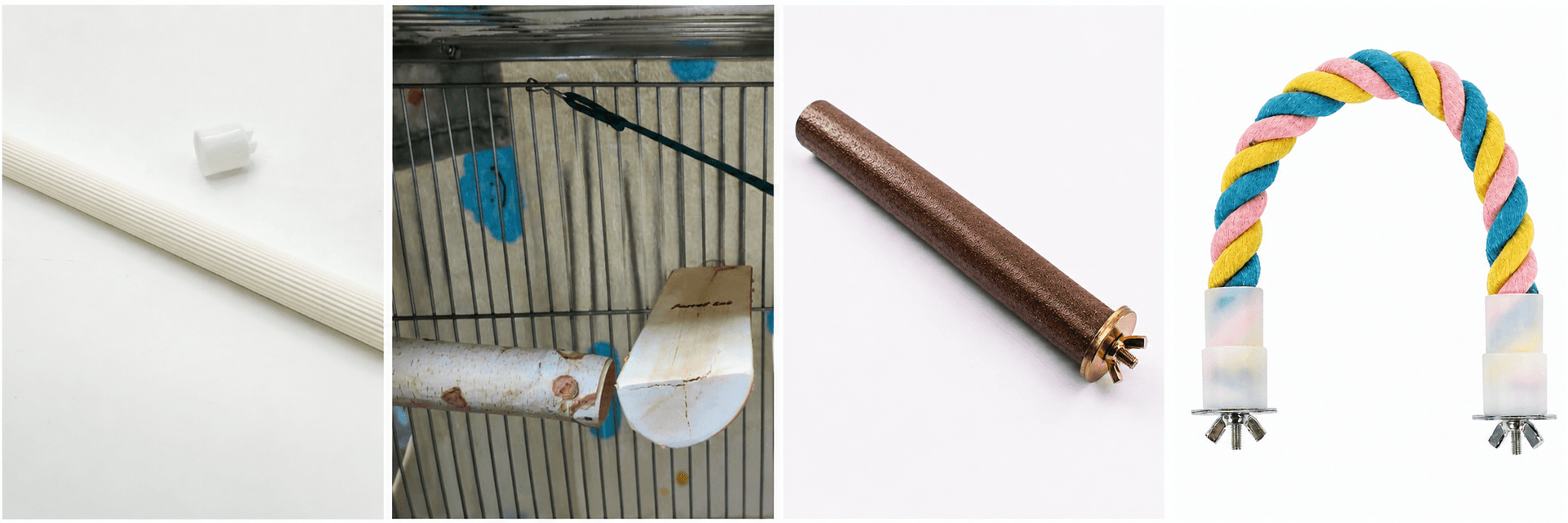
From left: plastic, natural wood, grooming, and rope perches.
Plastic Perch
Plastic perches are lightweight, easy to install, and usually the least expensive option.
However, their surfaces can be slippery and hard, making it more difficult for a parrot to maintain a firm grip or move quickly.
Natural Wood Perch
Natural wood perches are the closest alternative to the branches parrots use in the wild. Some retain their bark, giving parrots something to chew and providing varied stimulation for their feet. They can, however, be more expensive than other types of perches.
Before using a natural branch, make sure it comes from a tree species that is safe for parrots and has not been treated with chemicals. Any branch collected outdoors should be cleaned thoroughly and allowed to dry completely before use. If you cannot verify where a branch came from, it is safer not to offer it.
Grooming Perch
In the wild, a parrot’s claws and beak wear down naturally as it moves among branches. Indoor parrots do not have access to the same environment, so a grooming perch can help wear down the tips of the claws.
A grooming perch uses a rough surface to encourage gradual, natural wear.
Do not place it at the bird’s sleeping spot or wherever it spends most of its time simply to make the claws wear down faster. Constant exposure to the rough surface can irritate the feet and cause discomfort.
Instead, place it somewhere the parrot steps on briefly but regularly, such as in front of a food bowl or along a common route through the cage.
Rope or Fabric Perch
The greatest advantage of a rope or fabric perch is that you can shape it yourself. Bending it into different forms can create a more varied cage layout.
Parrots that enjoy the texture may also rub their beaks against it or chew it while playing.
However, once the material is damaged or begins to fray, claws can become caught in the fibers. A parrot may also swallow loose material. These perches therefore require regular inspection and maintenance.
Pellets and Diet
When welcoming a new family member, food is naturally one of the first things you think about.
Starting an entirely new diet on the first day, however, may be difficult for the bird.
Moving into an unfamiliar environment is already stressful. If familiar food suddenly disappears as well, the parrot may refuse to eat.
Keep the Existing Diet at First
Before adoption, ask the previous caregiver or breeder for the exact name of the food the bird currently eats. Buy it in advance or ask whether they can provide enough for the first few days.
Wait until the parrot is eating reliably and maintaining its weight in the new home before changing the diet gradually.
Careful observation is especially important during a diet transition. Pellet crumbs may make it look as though the bird has eaten, when it may only have crushed the pellets while playing. Continue monitoring its droppings, body weight, and actual food intake.
Choose Pellets for the Species and Individual Bird
Pellets are formulated feeds that combine multiple ingredients with vitamins, minerals, and other nutrients.
Unlike seed mixes, which allow parrots to select only their favorite items, pellets can help reduce nutritional imbalance. For that reason, many parrot owners use them as the foundation of the diet.
The same pellet is not appropriate for every parrot, however. Choose a product based on the bird’s species, size, age, activity level, reproductive status, and overall health.
Lories and lorikeets, whose natural diets are largely nectar-based, generally need a nectar formula rather than pellets as the foundation of their diet.
Macaws may benefit from a higher-fat formulation, while lower-fat food is generally more appropriate for cockatoos and Amazons. Research has not established a single ideal ratio for every bird, so the formulation should still be selected according to the individual parrot’s condition.
Food and Water Bowls
Stainless steel or washable ceramic bowls are generally preferable to plastic food and water bowls. Ceramic can break, however, so it must be handled carefully.
Some owners use bottle-style water dispensers, particularly during hot weather when open water becomes contaminated quickly or when they cannot refresh an open bowl frequently. Even then, water should not be left in the dispenser for too long. Replacing drinking water regularly is always the best approach.
Foods Parrots Can Eat
Parrots can eat many different foods, but common human ingredients such as garlic and scallions can be dangerous. Chocolate and avocado are also unsafe.
Naviary provides a service called Avium, where you can check whether a food is safe, unsafe, or should be offered only with caution.
Toys
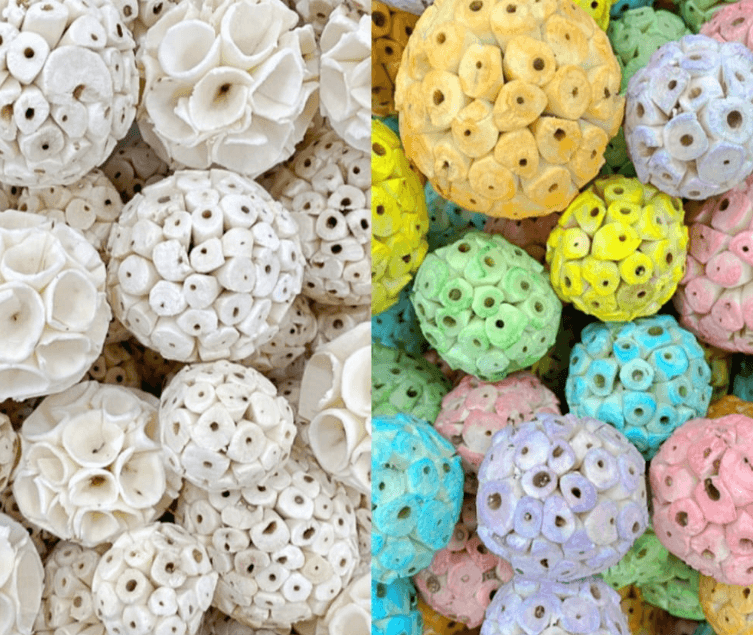
Sola balls are easy to shred, making them one of the toys many parrots enjoy most.
I consider toys essential for parrots.
They are not simply decorations that make a cage look attractive. They give parrots opportunities to engage in the kinds of enriching behaviors they would perform in the wild.
Environmental enrichment is extremely important for parrots living in our homes. Searching for food, shredding wood, exploring, and solving problems all have a major effect on their well-being.
Toys purchased from a parrot supply store can help, and you can also make toys at home.
For more information, see Why Foraging Matters for Parrots.
The most important consideration with any toy is always safety.
Toes or beaks can become trapped in holes, while long or loose fibers can wrap around the neck or toes. Discard damaged or excessively worn toys and replace them with safe ones.
Travel Carrier, Digital Scale, and Veterinary Care
Once you have prepared the cage, perches, food, and toys, the final steps are to get a travel carrier and a digital scale and identify a veterinary clinic that treats parrots.
You may not use a carrier often in everyday life, but it is essential whenever your parrot needs to travel.
Travel Carrier
You may need a carrier from the very first day you bring your parrot home. In a private adoption, the previous caregiver may transport the bird or you may collect it by car, but that is not always the case.
A carrier is also necessary for veterinary visits, whether your parrot becomes unwell or needs a routine health examination. It helps prevent contact with other parrots and animals at the clinic, making it an essential piece of safety equipment.
Digital Scale
Monitoring body weight is especially important during weaning and whenever a parrot is unwell. Even under normal circumstances, weighing the bird every day can provide a useful baseline.
Parrots instinctively hide signs of illness, so a change in weight may reveal a health problem before it becomes obvious in the bird’s appearance or behavior.
If the bird looks normal but loses weight rapidly, that may be a warning sign.
A dedicated perch can help the parrot stand securely on the scale.
Weigh the bird under similar conditions and at roughly the same time each day. Ideally, check its weight before the first meal. Record each measurement with the date instead of relying on memory.
If the bird continues to lose or gain an unusual amount of weight, consult an avian veterinarian.
Naviary is also developing a system for recording and managing parrots’ weight, meals, and health changes. Our in-house software makes it possible to track these details more precisely and view weight changes at a glance in graphs.
Find a Veterinary Clinic That Treats Parrots
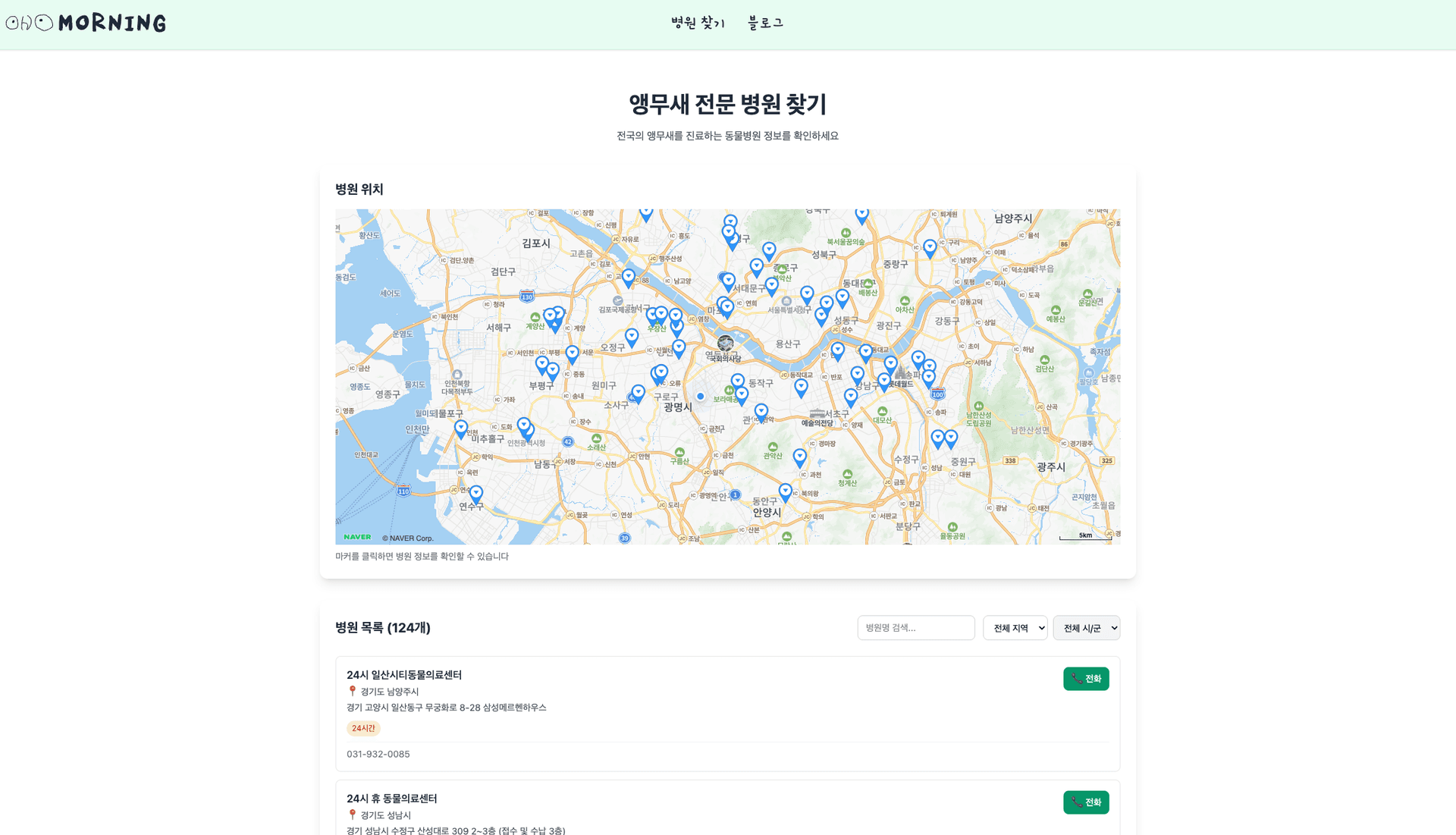
AngMorning is Naviary’s service for finding veterinary clinics that treat parrots.
Unfortunately, not every veterinary clinic in South Korea treats parrots.
Even some clinics that advertise exotic-animal care focus primarily on reptiles rather than birds. Make sure there is a clinic near you that can actually examine and treat parrots.
It is best to identify one before adoption. You can find nearby clinics through AngMorning, a service developed by Naviary.
Conclusion
A good environment is not simply a space filled with expensive supplies and as many toys as possible.
It should be a home where your parrot can eat, rest, and play safely.
Use your initial setup as a foundation and continue improving it together with your bird. Help your parrot become comfortable with objects it is afraid of—or remove them when necessary. Try moving a favored perch or adjusting the layout and materials as you learn what works.
Observing what your parrot enjoys and continuing to adapt the environment around those preferences is part of what it means to share your life with a companion animal.
Small habits—replacing the water every day, checking toys for damage, and recording body weight and food intake—are the first steps toward a happy life with your parrot.
Naviary provides prospective adopters with thorough guidance before adoption and continued support afterward.
If you have more questions while preparing to adopt, please contact Naviary.
In the next article, we will look at what to do on your parrot’s first day at home. Stay tuned!