
 Parrot Blog
Parrot Psittacosis: Symptoms, Testing, Transmission, and Prevention
This guide covers psittacosis, or avian chlamydiosis, including Chlamydia psittaci, bird-to-human transmission, symptoms, testing, and prevention.
 Changhwan
Naviary Parrot Disease Guide
Introduction
If you keep parrots long enough, there are a few disease names you are almost guaranteed to come across.
PBFD, PDD, APV, psittacosis, and others like them. These are diseases every parrot guardian should know, but when you first hear those names, they can feel confusing and honestly a little scary.
After PBFD, PDD, and APV, this time I want to cover the fourth disease in the series: psittacosis.
Psittacosis is a little different from the diseases we covered earlier.
PBFD, PDD, and APV are mainly about infection control inside a bird population. Psittacosis also matters because it is a zoonotic disease, which means it can spread from birds to people.
So this disease does not end with "my bird is sick." It can involve guardians, breeders, veterinarians, pet shops, and anyone who regularly handles birds.
In this article, I’ll go over what psittacosis is, what signs it can cause in parrots, what risk it poses to people, and how to think about testing and prevention.
What is psittacosis?
Psittacosis is the common name used for human disease. In birds, the condition is also called avian chlamydiosis.
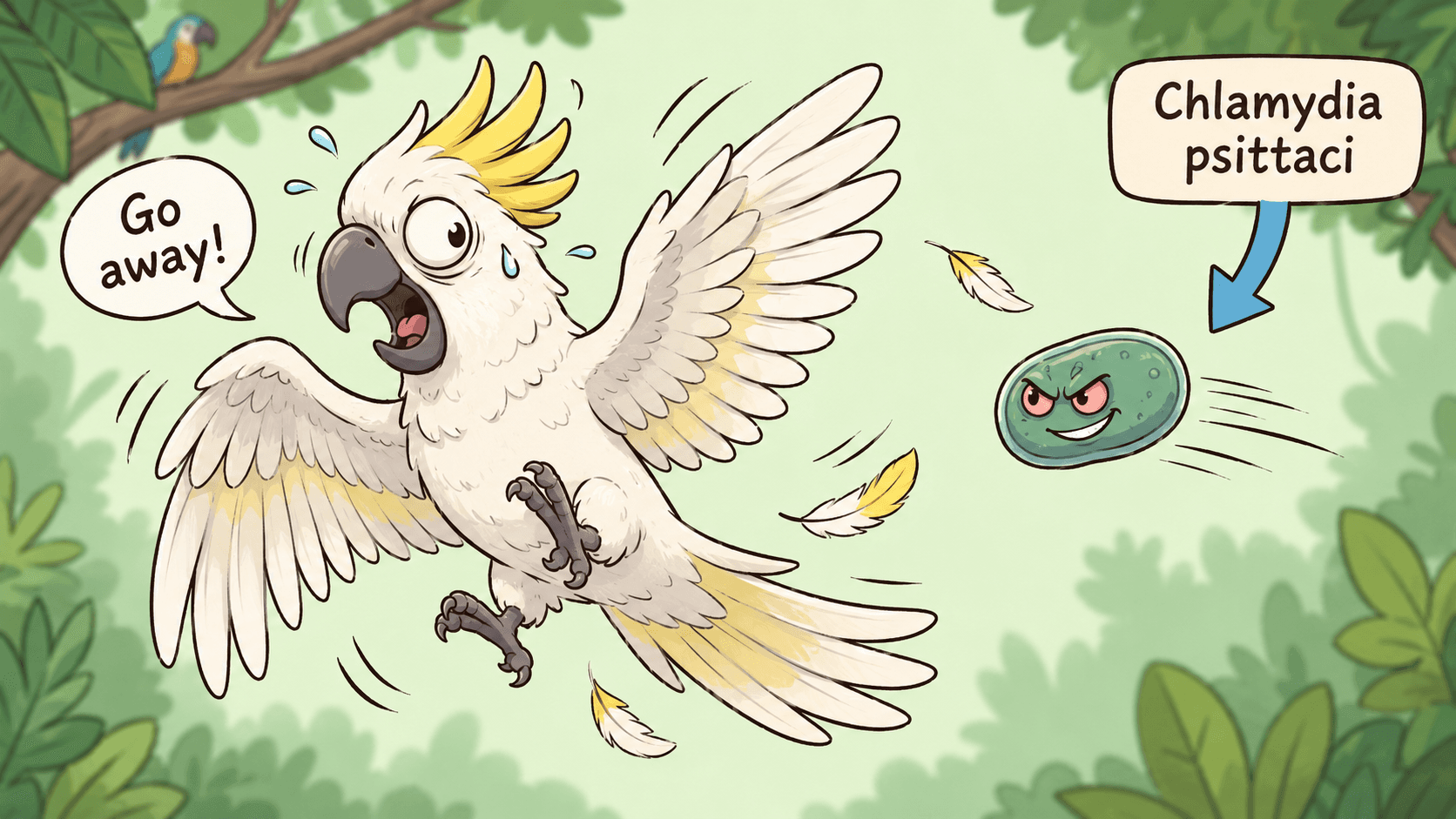
The causative organism is a bacterium called Chlamydia psittaci.
In older papers and resources, you may also see the name Chlamydophila psittaci. The review paper I used for this article has Chlamydophila psittaci in the title. More recent resources, however, commonly use Chlamydia psittaci again.
The name matters less than the biology.
Psittacosis is bacterial, not viral. More specifically, C. psittaci is an intracellular bacterium that grows inside host cells. That makes it harder to handle than ordinary bacterial culture, and diagnosis is not always straightforward.
There is another common misunderstanding.
Because the name is often associated with parrots, it is easy to assume only parrots are involved. That is not true.
The review paper explains that C. psittaci infection is not limited to psittacine birds. It has been found across many bird species. Parrots and pigeons are especially important reservoirs, but ducks, turkeys, chickens, gulls, herons, and other birds can also be involved.
A 2020 systematic review points in the same direction. Source tracing for human psittacosis has traditionally focused on parrot-like birds, but when the literature is gathered and scored, strong evidence also exists for zoonotic transmission from poultry such as turkeys, chickens, and ducks.
In other words, even though people often call it parrot fever, this is really a disease that has to be understood across birds and humans together.
What symptoms can it show?
Psittacosis can be frustratingly vague.
Some birds become acutely and severely ill. Some remain chronically infected and only start showing signs when stressed. Others may look normal while still shedding the organism.
Common signs can include:
- lethargy
- reduced appetite
- weight loss
- eye discharge or conjunctivitis
- nasal discharge, sneezing, or respiratory signs
- diarrhea
- green or yellow-green droppings
- fluffed feathers
- liver or spleen involvement
- in severe cases, pneumonia, shock, or death
That said, green droppings do not automatically mean psittacosis. Diet, liver function, digestion, and other infections all need to be considered.
The opposite is also true. Mild signs do not make the disease safe to ignore.
The review paper describes how many psittacine birds can become chronically infected and may not show clear clinical signs until they are stressed. A bird in that state may look healthy to its guardian, but still shed bacteria intermittently and become a source of infection for other birds or people.
That is what makes psittacosis difficult.
A visibly sick bird is not the only risk. A healthy-looking bird can also be a source of infection.
How does psittacosis spread?
The key transmission routes are respiratory secretions and droppings.
Infected birds can shed the organism through feces and respiratory secretions such as nasal discharge. When those materials dry, they can become tiny dust particles. Other birds or people may become infected by inhaling that dust.
So with psittacosis, you need to be careful not only about direct contact, but also about dry dust and aerosols.
The review paper explains that shedding is not always constant and can be reactivated by stress. Examples include:
- long-distance transport
- overcrowding
- breeding
- egg laying
- nutritional deficiencies
- chilling
- treatment or handling stress
This is especially important in breeding environments.
New birds arrive, carriers move between spaces, breeding and egg laying happen repeatedly, and multiple birds share the same air. That is why psittacosis cannot be managed as "we tested one bird, so we are done."
The main transmission routes can be understood this way:
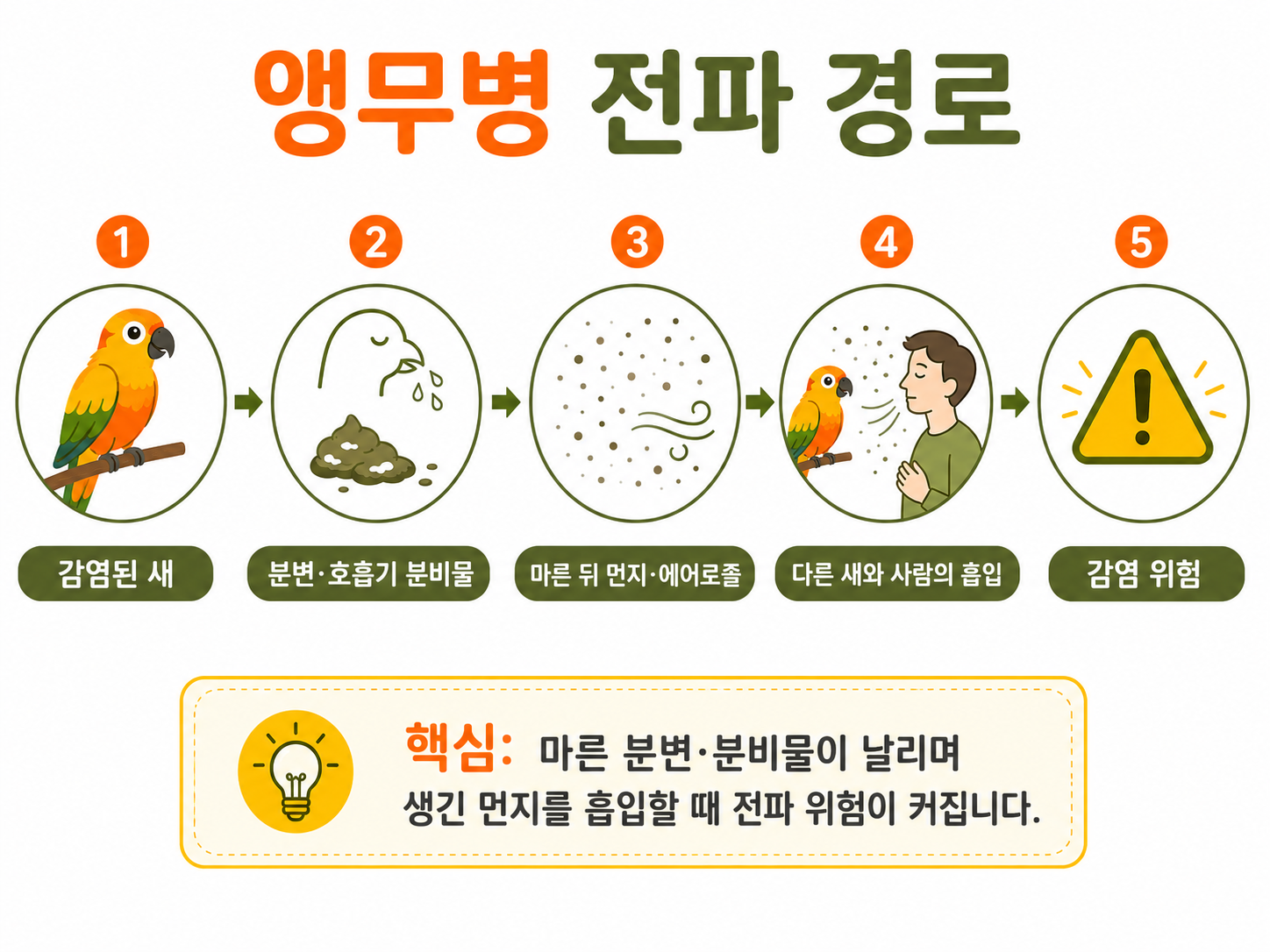
Transmission risk increases when dried droppings and secretions become dust or aerosols that birds and people can inhale.
- inhaling dust from dried droppings or secretions
- close contact with an infected bird
- contaminated cages, carriers, feeders, drinkers, or cleaning tools
- parent birds feeding chicks by regurgitation
- contaminated nest environments
- less commonly, bites, wounds, or external parasites
Vertical transmission through eggs has been reported in several bird species, although it appears to be relatively uncommon. In a breeding setting, however, it is still a risk worth respecting.
What risk does it pose to people?
Psittacosis can infect humans.
People most often become infected by inhaling dust contaminated with dried droppings or respiratory secretions from infected birds. Beak-to-mouth contact, bites, and handling infected feathers or tissues can also create risk.
The literature describes the incubation period in people as usually around 5-14 days. In people, the symptoms can look like a cold or flu at first.
- dry cough
- fever and chills
- headache
- muscle aches
- fatigue
- shortness of breath
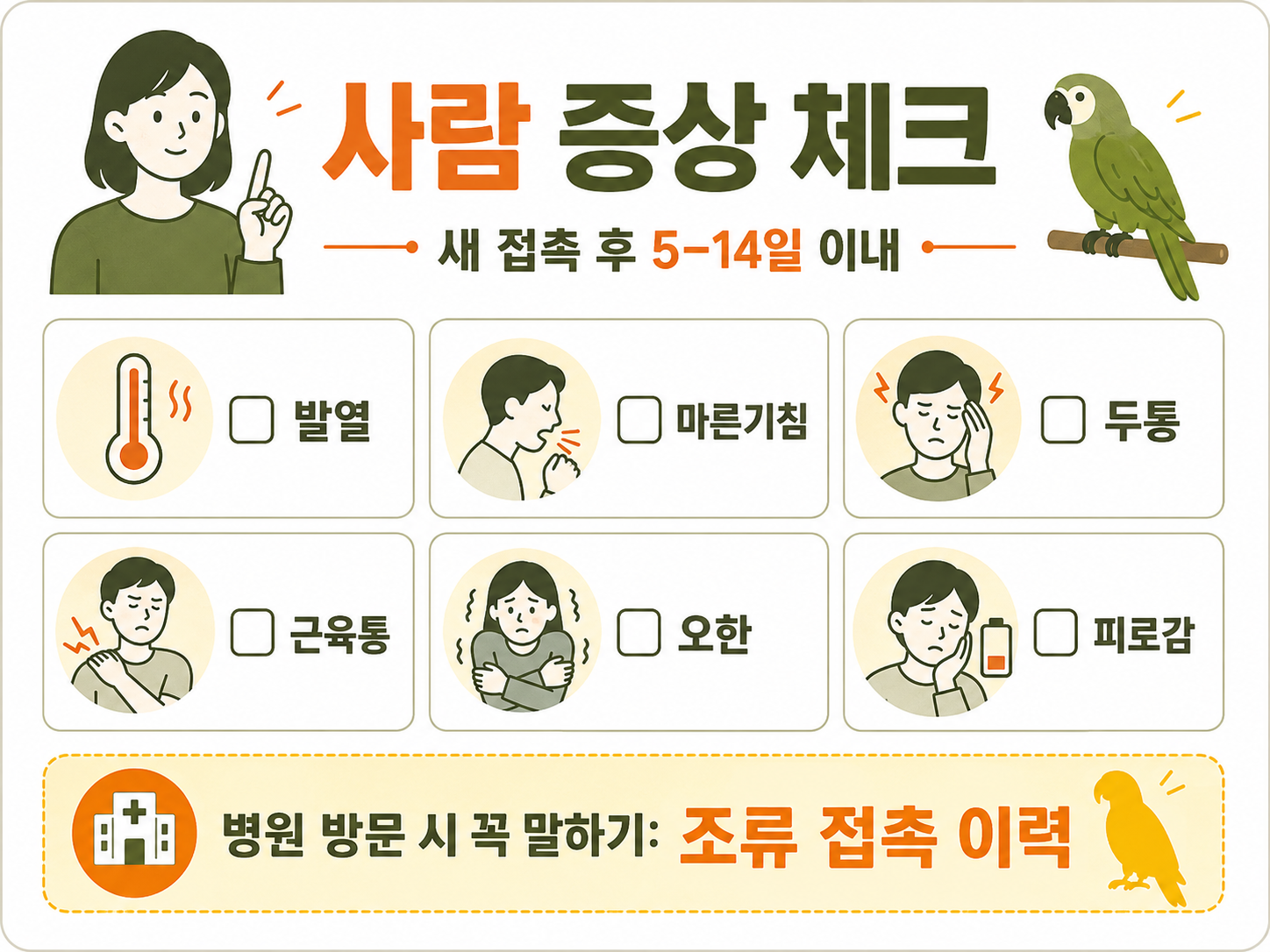
If you feel flu-like symptoms after bird exposure, tell the clinic about your bird contact history.
The problem is that it may not stop there.
Most people recover with appropriate treatment, but some cases can progress to pneumonia, endocarditis, hepatitis, or neurologic complications. Fatal outcomes are described as rare with proper treatment, which is exactly why early recognition and treatment matter.
If you develop a flu-like illness after handling birds or cleaning cages, it is better not to brush it off. When seeing a healthcare provider, make sure to mention bird exposure. Without that detail, psittacosis may not be the first thing a clinician considers.
Human-to-human transmission has been reported as possible, but it is considered rare.
How should testing be handled?
Testing for psittacosis is not as simple as "one PCR and we are done."
In birds, nucleic acid amplification tests such as PCR can be used, and serology can also be used as supporting information. Each has limits.
PCR looks for genetic material from the organism, so it can help detect current shedding. But shedding may be intermittent, so a single negative result does not always prove that the bird is completely safe.
Serology looks for antibodies, which can make it hard to separate past exposure from current infection. Early in infection, antibody levels may not be high enough yet.
The review paper notes that in early infection, choanal or oropharyngeal swabs can be more consistent than fecal swabs for detecting the organism. The actual sample choice should always be made with an avian veterinarian.
In practice, testing should be interpreted like this:
- If the result is positive, evaluate not only that bird but also the other birds sharing the same space.
- If the result is negative, repeat testing may still be needed depending on exposure history, signs, and timing.
- If antibiotics have already been used, results can become harder to interpret.
- A suspected bird should be isolated while waiting for results.
Testing matters. But testing needs context.
Blocking transmission matters more than just treating the bird
Because psittacosis is bacterial, antibiotics may be used under a veterinarian's direction. In people, healthcare providers may also prescribe antibiotics when psittacosis is suspected or diagnosed.
But the risky thought is this: "There are antibiotics, so it is fine."
Treatability and flock-level manageability are not the same thing.
The bird's environment, exposed flockmates, contaminated dust, cleaning tools, and carriers all need to be managed together. Cleaning method matters because dried droppings and secretions can become airborne dust.
It is better to wet cages or surfaces before cleaning so contaminated dust does not become airborne. Dry sweeping or vacuuming can push contaminated dust into the air.
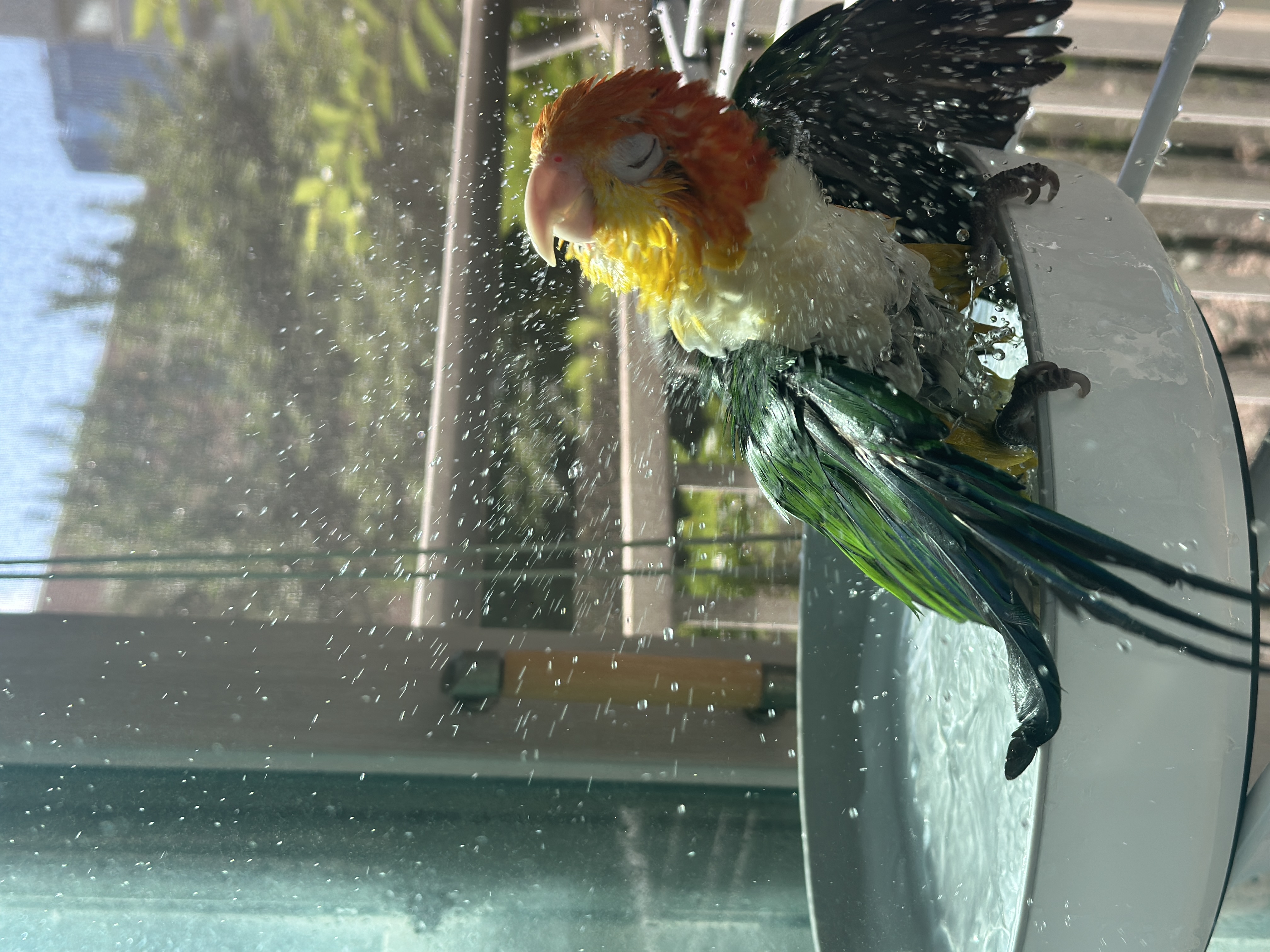
Wet surfaces before cleaning so dry dust does not become airborne.
The prevention rules are simple, but they matter because they have to be followed consistently.
- Do not introduce a newly acquired bird directly to existing birds.
- During quarantine, work with an avian-capable veterinarian for health screening and disease testing.
- Keep cages, feeders, and water bowls clean, and avoid overcrowding.
- Wet surfaces before cleaning so dust does not become airborne.
- Use gloves and an appropriate mask when handling a suspected bird or its cage.
- Prevent wild birds from accessing feed or bird housing areas.
- If a bird is positive or strongly suspected, follow veterinary guidance for isolation, treatment, and retesting.
Psittacosis management is ultimately about hygiene and records.
If you do not know when a bird arrived, which birds shared airspace, or which carrier and tools were used, tracing an infection becomes much harder. In a breeding environment, individual records and movement records are just as important as disease testing.
Conclusion
Psittacosis may sound familiar because the name is common, but it should not be treated casually.
To summarize it briefly:
- Psittacosis is a bacterial disease caused by Chlamydia psittaci
- birds can be asymptomatic or chronically infected
- dried droppings and respiratory secretions can become infectious dust
- it is a zoonotic disease that can infect people
- one test result should not be interpreted without exposure history and clinical signs
- prevention depends on quarantine, wet cleaning, disinfection, records, and stopping spread
Of course, if you suspect psittacosis or your parrot simply seems unwell, it is much better to visit a nearby clinic than to rely on visual guesses alone. You can check nearby clinics through our service, Angmorning.
At Naviary, our operating principles for infectious disease control are:
- Immediately isolate any bird suspected of infection
- If a suspected case appears, review the entire breeding center population
- Disinfect, replace, or discard all items used by the suspected bird
These are the principles we operate by. In a breeding center, infection in one bird can affect other individuals and the breeding program as a whole, so preventing spread and protecting the group must be managed more strictly than care for one individual alone.
Psittacosis is especially important because people have to be considered too.
So we need to be careful. That is not excessive. It is the baseline.
In the next article, I’ll cover how to interpret parrot disease test results in a more practical way.
References
-
Taher Harkinezhad, Tom Geens, Daisy Vanrompay. Chlamydophila psittaci infections in birds: A review with emphasis on zoonotic consequences. Veterinary Microbiology 135, 68-77. (2009)
-
Lenny Hogerwerf, Inge Roof, Marianne J. K. de Jong, Frederika Dijkstra, Wim van der Hoek. Animal sources for zoonotic transmission of psittacosis: a systematic review. BMC Infectious Diseases 20, 192. (2020)