
 Parrot Blog
Parrot APV: Symptoms, Testing, Transmission, and Prevention
This guide covers the main symptoms of APV in parrots, how testing is approached, its relationship with polyomavirus, and key management principles for preventing spread.
 Naviary
Naviary Parrot Disease Guide
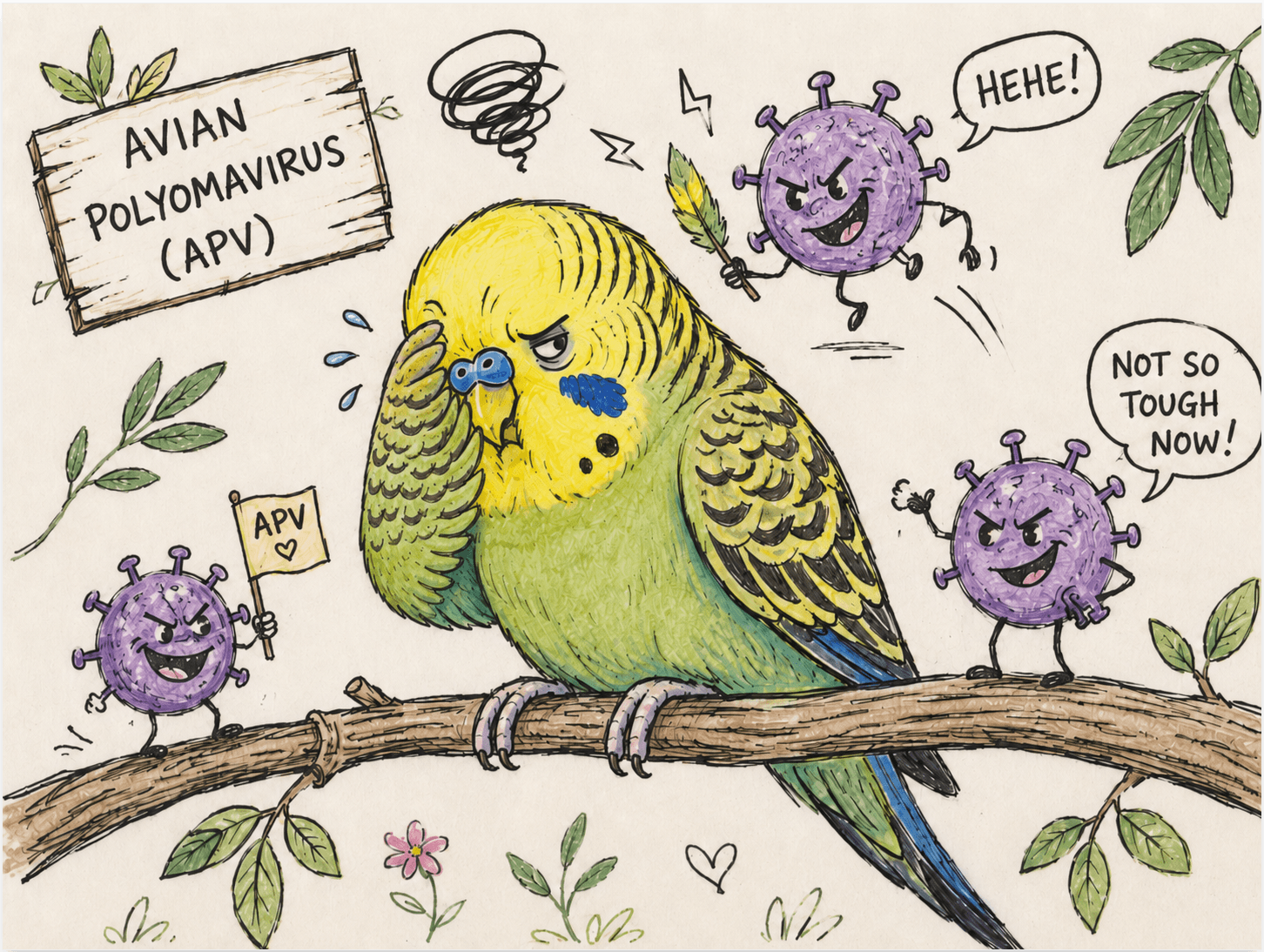
This article contains a photo of a parrot affected by APV.
Introduction
If you keep parrots long enough, there are a few disease names you are almost guaranteed to come across.
PBFD, PDD, APV, psittacosis, and others like them. These are diseases every parrot guardian should know, but when you first hear those names, they can feel confusing and honestly a little scary.
After PBFD and PDD, this time I want to cover the third disease in the series: APV.
What is APV?
APV stands for Avian Polyomavirus. As the name suggests, it is a polyomavirus that can cause disease in birds.
In the past, it was also called BFDV, or Budgerigar Fledging Disease Virus. That name came from the way the disease was first recognized: young budgerigars dying in large numbers around the fledging period.
APV is a non-enveloped DNA virus. Non-enveloped viruses are generally more resistant and durable in the environment than enveloped viruses.
In practical terms, that means the virus can survive for a long time in droppings, feather dust, contaminated husbandry tools, and contaminated spaces.
That is why APV can also spread easily through the environment.
What symptoms can appear?
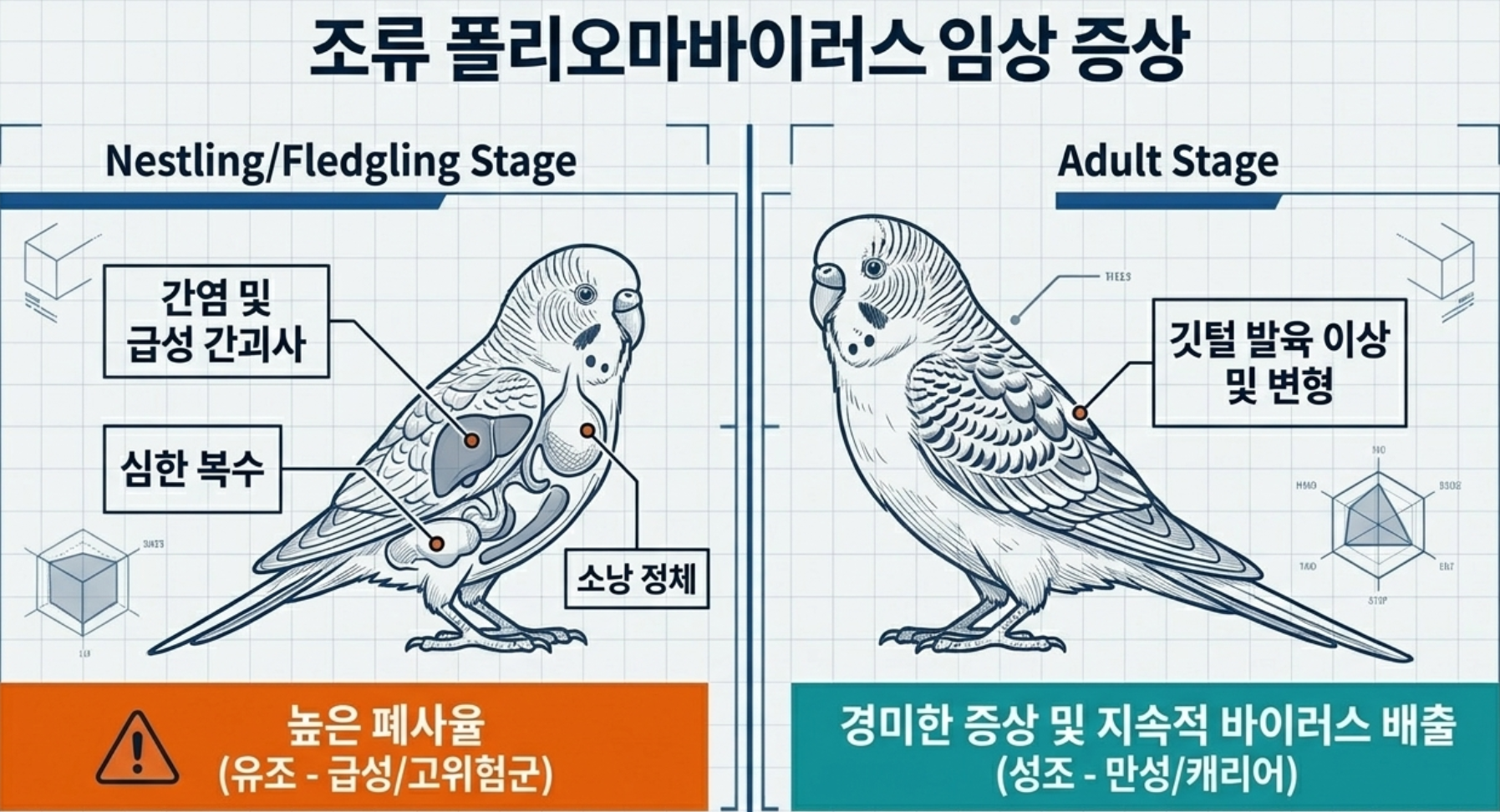
A comparison of symptoms in young and adult birds. APV can be extremely dangerous for young birds.
APV tends to look different depending on the bird's stage of development.
In young or immature birds, mortality can be very high, and signs may include:
- sudden death
- hepatitis
- ascites
- hydropericardium, or fluid around the heart
- subcutaneous bleeding
- feather abnormalities
- diarrhea
- reduced appetite
- lethargy
Because it can be so fatal, APV needs to be treated very seriously.
In adult birds, on the other hand, the disease often causes only mild signs or passes without obvious symptoms. Feather abnormalities can still appear, but the absence of dramatic symptoms does not mean it is safe to relax.
Even if an adult bird shows almost no symptoms, that does not mean the bird has fully cleared the infection. It can still act as an asymptomatic source of infection. A bird may look normal while shedding virus through droppings, feather dust, and other materials, so caution is essential.
Warning: this section contains a photo of a bird with disease-related abnormalities
This image may be distressing, so it is blurred by default. Reveal it only if you want to view the original.
How does APV spread?
APV is a highly contagious virus. It mainly spreads through droppings, feather dust, secretions, and contaminated environments. In other words, materials shed by an infected bird can infect other birds when they come into contact with them.
It can also spread vertically. If parent birds are infected with APV, they may pass the virus to their chicks through the egg.
Polyomavirus tends to favor rapidly dividing cells, so it mainly targets tissues such as the liver, kidneys, spleen, skin, and feather follicles. Because young birds have rapidly developing bodies and immature immune systems, sudden death is more common in them, which is why extra caution is needed.
In fact, a study of 217 companion parrots in Korea from 2016 to 2019 found 10 birds that tested positive for APV. The positive cases were not limited to one specific species. APV can infect many parrot species, including Indian ringneck parakeets, budgerigars, African grey parrots, Quaker parrots, conures, and black-headed caiques.
How are testing and treatment handled?
Testing is usually done by PCR using droppings, oral swabs, or cloacal swabs. In adult birds, the virus may be shed intermittently, so repeated testing may be needed to confirm the result.
As for vaccines, an inactivated vaccine was developed in the late 1990s, and some studies reported that it helped parrots form antibodies and defend against viral infection. Still, in practical terms, there is no widely available definitive treatment at this point.
Also, avian polyomavirus can mutate relatively quickly, which can make vaccine effectiveness difficult to rely on.
So when infection occurs, care usually focuses on:
- supportive care
- management of secondary infections
- nutritional support
The goal is to help the parrot's own immune system get through the infection. Supportive care is not a direct cure. It means helping the bird recover on its own through nutrition, hydration, temperature management, and similar care.
If you keep multiple birds, a confirmed positive bird should be isolated so there is no contact with the other parrots. This is especially important if there are young birds in the group, because the risk of death rises sharply after infection.
That is why the most important thing is always prevention.
Prevention
- When bringing home a new bird, isolate the bird for a set period before introducing it to existing birds, and run disease screening first.
- Adult birds without symptoms may still be infected with the virus. Regular testing is necessary.
- If there is a positive bird, disinfect and replace materials in the areas where the bird stayed, using an appropriate disinfectant, to reduce the risk of environmental transmission.
Conclusion
APV can be extremely fatal for young parrots, and it is a highly contagious disease. It becomes even more dangerous because adult birds can often remain asymptomatically infected.
To summarize it briefly:
- APV is highly contagious and can be extremely fatal for young parrots
- asymptomatic infection is common in adult birds, which increases transmission risk
- transmission must be considered together with environmental management
- testing matters, but results should never be interpreted without context
- in the end, early detection and blocking spread are the most important points
Of course, if you suspect APV or your parrot simply seems unwell, it is much better to visit a nearby clinic than to rely on visual guesses alone. You can check nearby clinics through our service, Angmorning.
At Naviary, our operating principles for infectious disease control are:
- Immediately isolate any bird suspected of infection
- If a suspected case appears, conduct a full review of the breeding center population, including PCR testing of all birds
- Incinerate or sterilize all items used by the suspected bird
These are the principles we operate by. In a breeding center, infection in one bird can affect other individuals and the breeding program as a whole, so preventing spread and protecting the group must be managed more strictly than care for one individual alone.
And of course, preventing infection in the first place matters most. That is why prevention remains the highest priority in how we run the breeding center.
References
- Sungryong Kim, Su-Jin Kim, Ki-Jeong Na. Molecular characteristics of Budgerigar fledgling disease polyomavirus detected from parrots in South Korea. (2022)
- Chen-Wei Wang, Yung-Liang Chen, Simon J. T. Mao, Tzu-Chieh Lin, Ching-Wen Wu, Duangsuda Thongchan, Chi-Young Wang, Hung-Yi Wu. Pathogenicity of Avian Polyomaviruses and Prospect of Vaccine Development. (2022)
- Ortwin Rott, Manfred Kröger, Hermann Müller, Gerd Hobom. The Genome of Budgerigar Fledgling Disease Virus, an Avian Polyomavirus. (1988)